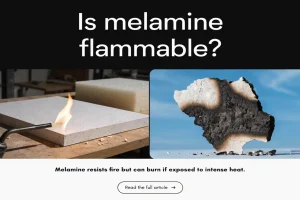
Is melamine flammable?
Tech Blog Is melamine flammable? “Is melamine flammable?” Many people mistakenly classify all plastic-like materials as flammable and worry about fire risks when using or

Melamine powder (chemical formula C₃H₆N₆, IUPAC: 1,3,5‑triazine‑2,4,6‑triamine) is a high‑nitrogen white crystalline intermediate, the building‑block for melamine‑formaldehyde (MF) resin, melamine moulding compound, laminates and melamine‑ware. So which compound is used for the preparation of melamine?
Urea (carbamide, chemical formula CO(NH₂)₂) is the primary industrial‑scale compound used for preparing melamine. Almost all modern commercial melamine plants use urea as feedstock, rather than formaldehyde. Formaldehyde reacts with finished melamine to produce MF resin, but formaldehyde does not make melamine monomer itself.
The overall endothermic chemical reaction for urea‑to‑melamine conversion:
6 CO(NH₂)₂ → C₃H₆N₆ + 6 NH₃ + 3 CO₂
Six moles of urea thermally decompose at high temperature, forming one mole of melamine, plus ammonia and carbon dioxide as recyclable by‑products. Many factories recycle ammonia‑rich tail gas back to urea synthesis units to improve circular‑economy efficiency.
| Substance | Role |
| Urea CO(NH₂)₂ | Starting compound for manufacturing melamine monomer |
| Melamine C₃H₆N₆ | Pure crystalline intermediate chemical made from urea |
| Formaldehyde HCHO | Reacts with melamine to synthesize melamine‑formaldehyde (MF) resin; cannot produce melamine monomer |
| MF resin (melamine‑formaldehyde) | Condensation polymer: melamine + formaldehyde reaction product |
| Melamine moulding compound (MMC) | Blended powder: MF resin + cellulose filler + pigments + curing agents, for compression‑molding melamine‑ware |
To answer the core question: Which compound is used for the preparation of melamine? Urea (carbamide, CO(NH₂)₂) is the dominant starting compound for global industrial melamine manufacturing. Under high‑temperature (and high‑pressure or catalytic gas‑phase) conditions, urea thermally decomposes and cyclizes to produce melamine crystalline powder, releasing recyclable ammonia and carbon‑dioxide by‑products.
Do not confuse melamine‑monomer synthesis with downstream resin‑making. Formaldehyde is introduced only in the next step to react with finished melamine to make melamine‑formaldehyde resin and melamine moulding compound; it does not create melamine itself. Understanding this raw‑material chain helps chemical purchasers and resin formulators evaluate supply‑chains, technical datasheets, and avoid common material‑terminology mix‑ups.

Tech Blog Is melamine flammable? “Is melamine flammable?” Many people mistakenly classify all plastic-like materials as flammable and worry about fire risks when using or

Tech Blog Why can’t melamine be microwaved? If you use melamine tableware for home dining, school cafeterias, or restaurant service, you have likely seen the
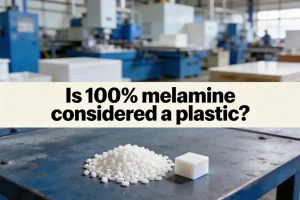
Tech Blog Is 100% Melamine Considered a Plastic? Shoppers, tableware buyers, and material engineers often ask a critical question: Is 100% melamine considered a plastic?

JINGJIANG MELAMINE POWDER
© JINJIANG MELAMINE