jinjiang melamine

Tech Blog

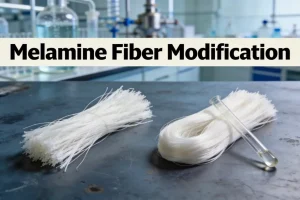
Melamine Fiber Modification

Melamine‑formaldehyde fiber (MF fiber, commercial-grade Basofil) is a well‑known, halogen‑free, high‑performance flame‑retardant fiber. It has no melt‑drip performance, excellent high‑temperature and chemical corrosion resistance, a limiting oxygen index (LOI) above 27 %, and a long‑term service temperature of up to 200 °C. It is widely demanded for fire‑protection textiles, high‑temperature filtration materials, aerospace components and electronic‑device protective materials.

Nevertheless, melamine resin is a typical thermosetting polymer. Unmodified melamine fiber faces critical technical bottlenecks: poor spinnability of the spinning dope, high brittleness, insufficient toughness, and a short storage life for the spinning solution. These drawbacks limit large‑scale commercial production and promotion in high-end applications. This article reviews mainstream modification strategies for melamine fiber, including spinning‑solution optimization, mechanical‑property reinforcement and flame‑retardancy enhancement. It provides practical guidance for material developers, fiber manufacturers, and R&D engineers.

Core Bottlenecks of Unmodified Melamine Fiber

Before modification, melamine‑formaldehyde fiber has several inherent drawbacks limiting industrialization:

  1. Unstable spinning solution: The prepolymer is prone to premature cross‑linking. Short storage time, phase separation and gelation frequently occur.
  2. Poor spinnability: The rigid triazine‑ring molecular structure leads to brittleness; obtaining continuous, defect‑free fiber is difficult.
  3. Low mechanical performance: High cross‑link density causes brittleness and low elongation at break. Pure MF fiber alone cannot meet textile processing requirements.
  4. Flame‑retardant gap for extreme conditions: Although intrinsically flame‑retardant, it still cannot fully meet the strict UL94 V‑0 standard under complex high‑temperature operating conditions.

Modification for Better Spinning‑Solution Performance

Spinning dope stability and spinnability are prerequisites for continuous fiber manufacturing. Current modification approaches are divided into physical blending and chemical modification.

Improve spinning‑solution storage stability

  • Polymer blending modification: PVA, PEG, and sodium alginate are common blending modifiers. PVA can react with formaldehyde and suppress side reactions, greatly extending solution shelf life. Adding a PEG‑thiourea compound system helps obtain a transparent, stable spinning dope.
  • Nano‑inorganic modification: Surface‑treated nano‑SiO₂ (KH‑570 coupling agent modification) improves particle dispersion and inhibits premature cross‑linking.
  • Chemical co‑modification: Introduce phenol or urea to reduce melamine functional groups and slow the cross‑linking reaction rate. Glutaraldehyde and THEIC can also be used for graft modification to increase spacing between molecular chains. Some formulations extend the spinning‑solution’s valid storage time to 12 days.
  • Green solvent substitution: Ionic liquids replace traditional organic solvents, reducing environmental pollution while enhancing prepolymer solubility.

Optimize spinning‑solution spinnability

Spinnability is closely related to cross‑link density, molecular‑chain flexibility and solution viscosity.

  1. Benzoguanamine modification: Partially substituting melamine monomer improves compatibility, reduces side‑reactions with coagulation‑bath components, and decreases surface particle defects.
  2. Methyl‑etherified melamine resin: Suppresses excessive dissolution in coagulation bath and produces smoother fiber surface.
  3. Auxiliary fiber‑forming agents: Ethylene glycol acts as a plasticizer, enlarging triazine‑ring spacing and reducing spinning‑solution viscosity. PAN can partially replace PVA as a new fiber‑forming matrix to produce a composite fiber with a uniform surface.

Modification for Enhanced Mechanical Properties

High cross‑link density in melamine resin leads to fiber brittleness. The main goal of mechanical modification is to adjust cross‑link density and introduce flexible molecular segments via physical blending or chemical copolymerization.

Physical blending modification

  • PVA / PEG compound blending: The most widely adopted technical route. Optimized MF‑PVA blended fiber can reach a tensile strength of 4.29 cN/dtex and an elongation at break of 13.55 %.
  • Mineral‑filler compounding: Blending surface-modified basalt-fiber nano-fillers into the spinning dope boosts tensile performance through homogeneous dispersion.
  • Fiber‑blending post‑processing: Blending Basofil melamine fiber with viscose fiber improves fiber bulk and deformation adaptability for non‑woven fabrics.

Chemical copolymerization modification

  • Flexible‑segment comonomer: Copolymerization with 1,4‑cyclohexanedimethanol (CHDM) significantly increases elongation at break without sacrificing thermal stability.
  • Organosilicon modification: Grafting siloxane flexible segments onto MF molecular chains increases the distance between rigid triazine rings and improves intrinsic fiber toughness.
  • Benzoguanamine / terephthalaldehyde copolymerization: Raises tensile strength; some formulas increase breaking strength by 26.3 % with good phase compatibility and no phase separation.
  • Phenol‑urea co‑modification: Partially replacing melamine reduces raw‑material cost and improves fiber elongation to 5.82 %.

Modification for Higher Flame‑Retardant Performance

Melamine fiber is intrinsically flame‑retardant (LOI > 27 %), yet high‑end aerospace and firefighting protective materials demand further improvement in char‑layer compactness and high‑temperature anti‑combustion capacity. Two mainstream technical routes: molecular‑structure copolymerization and inorganic‑nanocomposite compounding.

Copolymerization molecular modification

  • Resorcinol copolymerization builds a dense, cross‑linked aromatic‑ring network, raising LOI to 34.5 %.
  • Copolymerization with fluorine-containing aromatic monomers achieves LOI 32.5 %, but fluorine‑based reagents pose potential biological‑toxicity risks, limiting large‑scale green‑manufacturing applications.

Inorganic‑nanocomposite modification

  • Nano‑SiO₂ composite MF‑SiO₂ fiber: Forms a physical barrier char layer; LOI exceeds 35 %; the challenge lies in maintaining stable nanoparticle dispersion.
  • Metal‑ion (Al³⁺) modification: Promotes free‑radical recombination during combustion, strengthening flame resistance. But metal‑ion addition may trigger surface holes and reduce mechanical properties.
  • Coagulation‑bath adjustment: Adding boric acid to the coagulation bath can raise the LOI of MF‑PVA composite fibers to 40 %, though it increases fiber surface roughness.
  • Polyimide compounding: Introduce a high‑temperature‑resistant polyimide component that remains stable above 250 °C and improves overall high‑temperature flame‑retardant performance.

Production Status & Real‑World Applications

nternationally, BASF achieved commercial production of Basofil melamine fiber with an annual capacity of 3 000 t by adopting alkyl‑compound modification and a wet‑dry spinning process, widely used in firefighting protective clothing and aerospace insulation materials.

Domestic research in China started relatively late. Multiple institutes and enterprises have developed different technical paths:

  1. PVA‑MF wet‑spinning technology;
  2. Cellulose‑modified dry‑jet wet‑spinning with ionic‑liquid green solvent;
  3. Additive‑free dry‑spinning technology to realize continuous‑length fiber (strength range 0.9‑3.5 cN/dtex).

However, bottlenecks such as high production costs and insufficient large‑scale, stable production capacity still limit domestic mass‑market promotion.

Major application fields:

  • Fire‑retardant protective textiles: firefighting garments, high‑temperature workwear;
  • Industrial high‑temperature filtration: flue‑gas filter material;
  • Aerospace & electronics: thermal‑insulation and flame‑retardant non‑woven material;
  • Composite‑material reinforcing fiber.

Existing Challenges & Future Development Directions

  1. Balance between spinnability and final‑fiber performance: Many spinning‑solution modifiers enhance spinning feasibility but will compromise fiber heat‑resistance and flame retardancy. Formula trade‑off optimization is essential.
  2. Cost control: High‑purity raw materials and complex spinning processes drive up manufacturing costs; cost reduction is key to market adoption.
  3. Green‑manufacturing upgrade: Replace toxic organic solvents with an ionic‑liquid, water‑based system to reduce waste‑liquid discharge.
  4. Multi‑functional integration: Develop melamine fiber with flame‑retardant, antistatic, filtering, or adsorption functions to expand high‑value‑added applications.

conclusion-Melamine Fiber Modification

Melamine fiber is a promising halogen‑free flame‑retardant fiber material. Its industrial‑application barriers mainly come from poor spinning‑solution stability, poor spinnability and fiber brittleness. Current modification technologies focus on three directions: optimizing spinning‑solution performance, improving mechanical toughness, and further boosting flame‑retardant properties through physical blending and chemical copolymerization.

With continued breakthroughs in dry‑spinning, green solvents, and composite‑modification technologies, melamine fiber is expected to achieve low‑cost, large‑scale domestic production and broader adoption in fire‑protection, high‑temperature filtration, and aerospace industries.

Related Blogs

Melamine Fiber Modification
Jinjiang

Melamine Fiber Modification

Tech Blog Melamine Fiber Modification Melamine‑formaldehyde fiber (MF fiber, commercial-grade Basofil) is a well‑known, halogen‑free, high‑performance flame‑retardant fiber. It has no melt‑drip performance, excellent high‑temperature

Read More »

Jinjiang chemical

Contact Us to Start Your Business