jinjiang melamine

Tech Blog

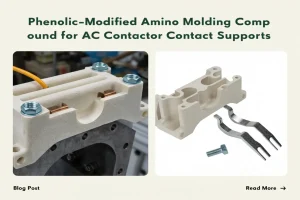
Phenolic Modified Amino Molding Compound for Contact Supports

AC contactors are core switching components in low‑voltage power distribution and motor‑control systems. The contact support is a critical moving structural part that bears repeated cyclic mechanical impact, frictional wear, arc‑generated heat, and electrical stress during millions of on‑off operations. Conventional unmodified amino molding compound (melamine‑formaldehyde molding powder) is easy to mold. It provides good electrical insulation, but it is highly brittle, has insufficient wear resistance, and poor heat‑deflection performance, often failing to meet long‑life industrial contact‑support requirements.

Phenolic‑modified amino molding compound blends novolac phenolic resin with amino resin to build semi‑interpenetrating polymer networks. This material balances mechanical toughness, wear resistance, thermal stability and dielectric properties. This article reviews formulation effects, lab test results, molding‑process interactions, micro‑scale modification mechanisms, and real‑world contactor mechanical‑life verification for material engineers, compound formulators, and low‑voltage‑appliance designers.

Challenges of Unmodified Amino Molding Compound for Contact Supports

Pure amino molding compound (AMC) has well‑known strengths for electrical parts: low molding shrinkage, good dimensional stability, high comparative tracking index (CTI). But for AC‑contactor contact‑support service conditions, key weaknesses limit service life:

  1. High brittleness: Low notched‑unnotched impact strength; prone to cracking under cyclic impact loads.
  2. Poor wear resistance: Repeated friction with plastic housing generates fine abrasive dust; dust deposits on metal contacts may cause conduction failure.
  3. Insufficient heat resistance: The heat-deflection temperature drops under sustained thermal load from contact arcing and Joule heating.
  4. Limited service cycles: Bench‑test mechanical life reaches only about 8.95 million cycles, below the 12‑million‑cycle industry acceptance threshold for high‑grade AC contactors.

These shortcomings push material developers to co-blend phenolic resin into amino molding compounds to modify them.

Experimental Formulation Setup

Researchers prepared modified compounds with novolac phenolic resin mass fractions of 0 % (pure AMC reference), 5 %, 10 %, 15 %, 20 %, and 25 %. All batches used the same filler, fiber, curing agent, release agent, and colorant.

Processing conditions:

  • Mould‑temperature window: 160 °C‑180 °C
  • Barrel temperature: 70‑105 °C
  • Injection pressure: 60‑100 MPa
  • Curing rate: 10‑20 s/mm

We followed ISO/GB/T standards for impact strength, flexural strength, deflection‑temperature‑under‑load, power‑frequency electric strength, and wear loss. We assembled finished contact supports into AC contactors for full‑scale mechanical‑life testing per GB/T 14048.4‑2020.

Key Test Results: Effect of Phenolic Resin Loading

Mechanical Properties

  • Unnotched impact strength: Peaks at 15 % phenolic content (11.57 kJ/m²), +47.9 % improvement vs. pure AMC. Above 15 %, impact strength declines gently but remains far above the reference sample.
  • Flexural strength: Maximum at 15 % phenolic loading (112.3 MPa), +41.1 % higher than pure amino compound. Excess phenolic slightly reduces flexural performance.

Thermal Performance

  • Pure AMC: 141.4 °C
  • 15 % phenolic: 239.1 °C (+69.1 % improvement)
  • 25 % phenolic: 243.2 °C. DTUL rises sharply from 0‑15 % loading; growth slows further above 15 %. Rigid aromatic phenolic segments increase the polymer network’s overall heat resistance.

Electrical Insulation Performance

Power‑frequency electric strength peaks at 15 % phenolic resin: 18.2 MV/m (+32.8 % vs reference). Further phenolic addition causes a minor drop while still maintaining high‑grade insulation values suitable for low‑voltage electrical components.

Wear‑Resistance Performance

Average wear loss continuously decreases as phenolic content increases:

  • Pure AMC: 0.0086 g
  • 25 % phenolic resin: 0.0011 g, ‑87.2 % wear‑loss reduction. A higher phenolic proportion significantly suppresses abrasive‑particle generation during cyclic friction, lowering the risk of contact contamination.

Finished‑Product Mechanical‑Life Verification

Phenolic contentAverage mechanical life (million cycles)
0 %8.95
5 %9.92
10 %10.97
15 %12.02
20 %12.05
25 %12.08

Key practical conclusion: 15 wt % or higher phenolic‑modified AMC can achieve ≥12 million mechanical cycles, meeting industrial long‑service‑life requirements for AC‑contactor contact supports.

Interaction Between Mould Temperature and Formulation

Within the 160 °C‑180 °C mould‑temperature operating range:

  1. 15 % phenolic resin shows an obvious synergistic effect with high‑temperature curing at 180 °C. Both impact strength and flexural strength improve roughly 8.7‑8.8 % compared to 160 °C mould temperature, promoting co‑condensation and uniform semi‑interpenetrating network formation.
  2. At 25 % phenolic loading, the benefit of high mould temperature diminishes; excessive phenolic may trigger partial phase separation and internal stress build‑up.
  3. Pure amino compound shows little performance change when raising mould temperature, as its curing reaction already completes fully at 160 °C.

Modification Mechanism: Semi‑Interpenetrating Polymer Network

FT‑IR and SEM analysis reveal the underlying mechanism:

  1. Chemical co‑condensation: Hydroxyl groups from phenolic resin react with methylol groups of amino resin to form covalent cross‑links, building semi‑interpenetrating polymer networks.
  2. SEM fracture morphology:
    • Pure AMC: Smooth fracture surface, typical brittle cleavage failure; weak fiber‑matrix interfacial adhesion.
    • 15 % phenolic-modified sample: Rough fracture surface with abundant plastic tearing, crack deflection, and fiber pull‑out; failure mode shifts from brittle to quasi‑tough fracture. Fiber surfaces are fully wrapped by the resin matrix.
    • 25 % phenolic sample: Partial interfacial debonding appears, with some decline in toughness.
  3. FT‑IR evidence: At the optimum 15 % loading, hydroxyl absorption peaks decrease, and methylene‑ether‑bond characteristic peaks maximize, indicating the highest cross‑link density. Excess phenolic consumes curing‑active sites and reduces cross‑link density.

The semi‑IPN network simultaneously improves stress‑dissipation capacity, interfacial bonding, heat resistance, and wear resistance.

Formulation Recommendation for Industrial Production

The phrase “melamine plastic” is common in commerce, but “plastic” here is the broad category for polymer materials, not thermoplastic. Melamine is always a thermoset resin.

Recommended optimum phenolic resin mass fraction: 15 %

  • Balanced comprehensive performance: mechanical strength, heat‑deflection, and electrical insulation reach maximum values.
  • Satisfies the 12‑million‑cycle mechanical‑life requirement for AC‑contactor contact supports.
  • Cost‑effective; avoids drawbacks brought by excessive phenolic addition.

Process suggestion:

  • Mould temperature: target 180 °C to realize synergistic curing effect for 15 % phenolic‑modified AMC.
  • Avoid increasing phenolic resin beyond 15 % unless wear‑resistance is your absolute top priority (for extreme‑friction scenarios, you may select 20‑25 % phenolic, accepting a slight drop in mechanical properties).

FAQ

Q1: Why not simply use pure phenolic molding compound for contact supports?

A: Pure phenolic molding compound has outstanding heat‑resistance and wear‑resistance, but has longer curing cycles, worse dimensional stability under repeated loads, and inferior CTI / arc‑resistance compared with amino‑base systems. Phenolic is better used as a modifying additive rather than as a 100 % matrix resin.

Q2: Can phenolic‑modified amino molding compound apply for other low‑voltage components?

A: Yes. It is also promising for relay moving parts and internal structural pieces of circuit breakers that require cyclic impact resistance and anti‑wear performance.

Q3: What will happen if mould temperature drops below 160 °C?

A: Co‑condensation reaction between phenolic and amino resin becomes insufficient. Cross‑link density decreases, impact strength and flexural strength degrade, and the finished part may fail to meet the 12‑million‑cycle criteria.

conclusion

Phenolic‑resin co‑blending modification is an effective technical path to overcome brittleness and poor wear‑resistance drawbacks of conventional amino molding compound for AC‑contactor contact supports.

At 15 wt % novolac phenolic resin loading, the compound forms a well‑developed semi‑interpenetrating polymer network. It achieves prominent gains in impact strength (+47.9 %), flexural strength (+41.1 %), heat‑deflection temperature (+69.1 %), and power‑frequency electric strength (+32.8 %). Finished contact supports reach 12.02 million mechanical cycles, satisfying long‑term industrial‑grade service demands. A mouldA mould temperature of 180 °C provides synergistic curing benefits for this optimum formulation. While higher phenolic content further improves wear resistance, it slightly reduces mechanical properties.

For low‑voltage‑appliance material engineers and molding‑compound formulators, phenolic‑modified amino molding compound delivers a cost‑balanced solution for high‑life moving thermoset insulating components.

Related Blogs

Melamine Fiber Modification
Jinjiang

Melamine Fiber Modification

Tech Blog Melamine Fiber Modification Melamine‑formaldehyde fiber (MF fiber, commercial-grade Basofil) is a well‑known, halogen‑free, high‑performance flame‑retardant fiber. It has no melt‑drip performance, excellent high‑temperature

Read More »

Jinjiang chemical

Contact Us to Start Your Business