jinjiang melamine

Tech Blog

What type of chemical is melamine?

What type of chemical is melamine? Often confused with polymers, plastics, or generic additives, melamine has a precise scientific classification with unique molecular traits that define its industrial behavior, safety profile, and end uses. This article clearly defines melamine’s chemical category, core properties, industrial roles, and common misconceptions to help you fully understand this widely used industrial chemical.

Exact Chemical Classification of Melamine

Melamine powder (CAS 108-78-1) is a synthetic, nitrogen-rich heterocyclic organic compound with the molecular formula C₃H₆N₆. Its official IUPAC name is 1,3,5-triazine-2,4,6-triamine, and it belongs to the 1,3,5-triazine subclass of organoheterocyclic chemicals.
To eliminate common confusion, here is a clear breakdown of its chemical identity:
  • Organic compound: Composed of carbon, hydrogen, and nitrogen, featuring a stable six-membered triazine ring molecular structure, the core foundation of its excellent chemical stability.
  • Heterocyclic compound: Its molecular skeleton contains nitrogen heteroatoms within the cyclic structure, distinguishing it from ordinary aliphatic organic chemicals.
  • Amino-functional chemical: Equipped with three active amino groups (-NH₂), enabling it to undergo condensation polymerization with formaldehyde.
  • Small-molecule monomer: Not a polymer, plastic, or resin itself. It acts only as a synthetic intermediate raw material for producing high-molecular polymer materials.
Melamine does not exist naturally; it is 100% synthetic and is industrially manufactured from urea via high-temperature catalytic decomposition and purification.

Core Physical & Chemical Properties of Melamine

Its unique chemical classification directly determines its physical and industrial properties, supporting its widespread application in resin synthesis and material manufacturing:
  • Appearance: Pure white, odorless crystalline powder at room temperature
  • Nitrogen content: Approximately 67% by mass, delivering inherent flame-retardant and high-stability characteristics
  • Solubility: Slightly soluble in water and hot ethanol, insoluble in most organic solvents
  • Thermal performance: No melting point; decomposes at around 345°C at high temperatures
  • Chemical reactivity: Active amino groups enable stable cross-linking reactions with aldehydes, forming rigid thermosetting polymer networks
  • Stability: Excellent acid and alkali resistance under normal temperature conditions, with stable chemical properties

Is Melamine a Polymer, Resin, or Plastic?

This is the most frequent misunderstanding in the industry. To clarify and accurately:
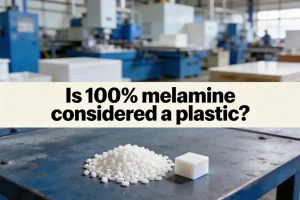
Melamine itself is NOT a polymer, resin, or plastic.
  • Melamine monomer: Small-molecule organic compound, the upstream chemical raw material
  • MF (melamine-formaldehyde) resin: Polymer product formed by the condensation reaction of melamine and formaldehyde
  • Melamine moulding compound (MMC): Composite powder mixed with MF resin, cellulose fillers, and functional additives
  • Melamine tableware & finished products: Thermoset plastic composites formed by high-temperature and high-pressure curing of MMC powder
In short, melamine is the raw material chemical, while melamine resin and melamine plastic are its downstream processed products.

Industrial Chemical Role of Melamine

As a high-purity triazine organic intermediate, melamine has irreplaceable industrial value, mainly used for synthesizing high-performance polymer materials:
  • MF resin synthesis: The largest application, used for decorative laminates, wood panel adhesives, and industrial coating cross-linkers
  • Food-grade moulding materials: Produces A5-grade melamine moulding compound for safe, shatter-resistant tableware manufacturing
  • Flame retardant additives: Widely used in intumescent flame retardant systems for plastics, coatings, and building materials due to high nitrogen content
  • Special chemical additives: Applied in paper wet-strength agents, textile finishing agents, and electrical insulation material modifiers

Safety & Regulatory Chemical Classification

In accordance with EU REACH and CLP regulatory standards, melamine has unified hazard classification labels for industrial circulation and application:
  • Carcinogenicity Category 2 (Carc. 2)
  • Reproductive Toxicity Category 2 (Repr. 2)
  • Specific Target Organ Toxicity Category 2 (STOT RE 2, urinary tract hazards from long-term exposure)
Note: Safety risks only apply to raw melamine monomer exposure. Fully cured food-grade melamine products have stable cross-linked structures with qualified monomer migration levels, complying with FDA and EU 10/2011 food contact standards for safe use.

FAQS

Q1: What type of chemical is melamine?

Melamine powder (CAS 108-78-1) is a synthetic nitrogen-rich heterocyclic organic compound (triazine derivative). It is a small-molecule chemical intermediate, not a polymer, resin, or plastic.

Q2: Is melamine organic or inorganic?

Melamine powder is an organic chemical composed of carbon, hydrogen, and nitrogen elements with a typical organic triazine cyclic molecular structure.

Q3: Is melamine a polymer or monomer?

Melamine is a monomer. It polymerizes with formaldehyde to generate macromolecular MF resin polymers and cannot be directly classified as a polymer material.

Q4: Is melamine a natural or synthetic chemical?

Melamine is a fully synthetic industrial chemical that does not occur naturally and is mass-produced from urea through high-temperature chemical reactions.

Q5: What is the difference between melamine and MF resin?

Melamine is a single small-molecule compound raw material, while MF resin is a polymer product synthesized from melamine and formaldehyde. The two have completely different chemical structures and properties.

conclusion

To answer the core question: What type of chemical is melamine? Melamine is a synthetic nitrogen-containing heterocyclic organic triazine compound (CAS 108-78-1) that serves as a key industrial monomer and chemical intermediate. It is fundamentally different from downstream MF resin, melamine moulding compound, and finished melamine plastic products.

Accurate melamine classification helps industrial buyers and formula engineers distinguish raw material attributes, standardize material selection, and avoid technical misunderstandings in resin synthesis, tableware manufacturing, and flame retardant material production, ensuring product quality and regulatory compliance.

Related Blogs

Is Melamine-Formaldehyde Brittle?
Jinjiang

Is Melamine-Formaldehyde Brittle?

Tech Blog Is Melamine-Formaldehyde Brittle? Melamine-formaldehyde resin is a widely used thermosetting polymer for tableware, decorative laminates, electrical components, and industrial coatings. Although it is

Read More »
Is melamine synthetic?
Jinjiang

Is melamine synthetic?

Tech Blog Is melamine synthetic? Is melamine synthetic? None of these substances occur freely in nature. Every commercial form of melamine‑based material is artificial via

Read More »

Jinjiang chemical

Contact Us to Start Your Business