How Melamine Is Used in Melamine Tableware
Tech Blog How Melamine Is Used in Melamine Tableware If you work with melamine or food-contact plastics, you already know that melamine has a complicated
The solubility of melamine is the result of the competition between “hydrogen bonding between molecules and water” and “intermolecular hydrogen bonding and weak polarity of molecules”.
The water-soluble properties of melamine also partially explain why it is illegally added to milk – because it has a high nitrogen content (66%) and low solubility, can impersonate proteins (estimated by measuring nitrogen content), does not significantly change the volume and physical appearance of the solution, and is not easily detected.
The core factor of melamine dissolution is the formation of hydrogen bonds with water molecules.
Water is a highly polar molecule, and the H (electronegativity) and O (electronegativity) in the molecule can form hydrogen bonds with melamine molecules, which is the key driving force for its dissolution.
Each N atom of melamine NH₂ contains one lone pair of electrons, which can form N… H-O hydrogen bonds with the positively charged H (O-H bond) in water molecules; at the same time, the negatively charged O in water molecules can also form O…H-N hydrogen bonds with the positively charged H (N-H bond) in melamine amino groups.
This bidirectional hydrogen bonding can encapsulate melamine molecules in water molecules, weaken the intermolecular forces between melamine molecules, and gradually disperse them into water. This is the core reason why melamine can dissolve in water.
Melamine powder is slightly soluble in cold water and soluble in hot water; at 20 ℃, the solubility is about 3.1 g/L, but it increases significantly with temperature. At 100 ℃, the solubility is 33g/L.
Although hydrogen bonding can promote dissolution, the molecular structure of melamine significantly limits its solubility, resulting in only “slight solubility” at room temperature.
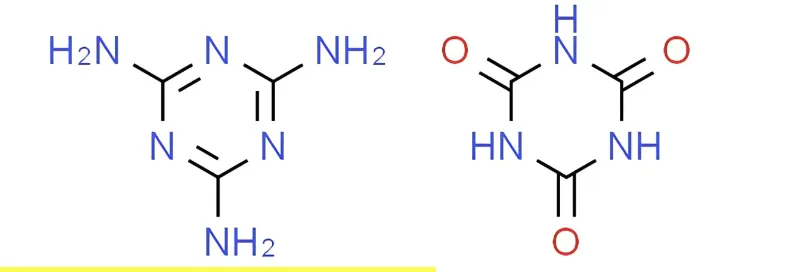
The melamine powder molecule has a polar amino group (-NH₂) and an electron-rich triazine ring, which makes it not only able to form hydrogen bonds, but also very good at forming hydrogen bonds with its own “kind”.
In solid melamine crystals, molecules are connected through a very dense and strong hydrogen-bonding network, forming a low-energy and very stable crystal structure.
When melamine is added to water, water molecules first need to break this strong hydrogen-bonding network to “dissolve and release” the melamine molecules. However, the hydrogen bonds formed between water molecules and melamine are not strong enough to compensate for the energy required to destroy melamine’s own crystals. Simply put, melamine molecules “prefer” to stay together rather than being surrounded by water molecules.
The molecular skeleton of melamine powder is a symmetrical hexagonal triazine ring (planar conjugated structure), with three -NH₂ atoms symmetrically distributed at 120° on the ring. Although the amino group is polar, the symmetrical structure causes the positive and negative charge centers of the molecule to basically overlap, greatly canceling out the overall polarity. This benzene-like symmetrical structure leads to increased non-polar strength, while melamine has polarity but is extremely weak.
The dissolution of solutes by water follows the principle of “similar solubility” – strongly polar water has limited ability to dissolve weakly polar melamine, far inferior to its dissolution effect on strongly polar solutes (NaCl, urea).
Although the molecule contains amine groups that can form hydrogen bonds, the benzene ring structure is similar, and the triazine ring at its core is a larger hydrophobic region. Although the amino group is hydrophilic, the hydrophobic properties of the entire molecule account for a significant proportion, which also contributes to its low solubility.
Melamine powdermolecules are highly symmetrical planar p – π conjugated molecules, with all atoms coplanar. This flat structure allows molecules to stack tightly together like “stacked plates”, further enhancing the stability of the crystal structure and making it more difficult for solvent molecules to insert and separate.
At high temperatures, the kinetic energy of water molecules increases, while also weakening the hydrogen bonds and van der Waals forces between melamine molecules. This more effectively disrupts the strong hydrogen-bond network between melamine molecules, making it easier for individual melamine molecules to hydrate and allowing more molecules to “break free” from the crystal surface and enter the solution.
Urea molecules are smaller and more easily destroyed by water molecules. The carbonyl group (C=O) of urea is highly polar and can form strong hydrogen bonds with water. This energy is sufficient to compensate for the energy required to destroy the crystal.
Urea molecules can also form hydrogen bonds between themselves, but their molecular structure does not form an extended, multidimensional, high-strength hydrogen-bond network like melamine. The hydrogen bonds in urea crystals are relatively weak.

Tech Blog How Melamine Is Used in Melamine Tableware If you work with melamine or food-contact plastics, you already know that melamine has a complicated

Tech Blog The effect of water temperature on the solubility of melamine The solubility of melamine is the result of the competition between “hydrogen bonding

Tech Blog What is the raw material of urea formaldehyde? Unlike natural materials, urea formaldehyde is purely synthetic, and its performance and safety depend directly

JINGJIANG MELAMINE POWDER
© JINJIANG MELAMINE