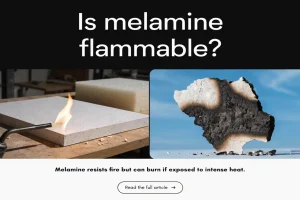

Is melamine flammable?
Tech Blog Is melamine flammable? “Is melamine flammable?” Many people mistakenly classify all plastic-like materials as flammable and worry about fire risks when using or

Polyurethane (PU) and epoxy coatings are widely used on tinplate, steel, automotive and construction metal substrates for anti-corrosion, decoration and surface isolation. However, conventional single-function coatings face two fatal industrial drawbacks:
1. Micro-crack failure risk: Scratches, thermal fatigue and mechanical impact generate invisible microcracks on coating surfaces. Corrosive brine, moisture and oxygen penetrate cracks, directly contacting the metal base and triggering rust, which shortens coating service life and raises maintenance costs drastically. Traditional coatings have no self-repair ability and require full recoating after damage.
2. High flammability hazard: Pure PU and epoxy resin burn rapidly under open flame, produce molten drips and toxic smoke, failing fire safety standards for machinery, building steel, and vehicle parts.
This research develops a dual-performance solution: urea formaldehyde resin (UF resin) /tung oil core self-healing microcapsules combined with halogen-free phosphorus flame retardants, blended into PU and epoxy matrix separately to fabricate integrated self-repair + flame-retardant protective coatings. The article fully discloses the optimized microcapsule synthesis process, microcapsule dosage screening, flame retardant matching test, scratch self-healing mechanism, UL-94 vertical combustion, EIS electrochemical anti-corrosion and salt spray test results, providing scalable formulas for metal coating manufacturers.
Strength self-repair rate:
Pure PU (0% MC): Only 2.23%, almost no repair capacity
PU/5%MC: 71.68% partial scratch recovery
PU/10%MC: 106.36% optimal balance of repair & mechanical loss
PU/15%MC: 157.66% maximum repair, but coating adhesion drops sharply
Adhesion test: Pure PU=4.29MPa; PU/10%MC=3.26MPa (minor decline, acceptable for metal substrates)
EIS anti-corrosion test: Scratched PU/10%MC soaked 24 h in 3.5% NaCl solution, impedance rises two orders of magnitude vs blank PU; tung oil film blocks corrosion medium penetration.
Water resistance: All microcapsule-loaded PU coatings soak 200 h without blisters, peeling, or rust marks.
Strength self-repair rate:
Adhesion comparison: Pure EP=5.86MPa; EP/10%MC=4.36MPa, far higher than PU/10%MC
Salt spray performance: 20-day neutral salt spray test on scratched EP/10%MC, no rust around the scratch, self-healing film fully isolates the metal base.
PU Coating System
Epoxy Coating System
Formula 1: Self-Healing Flame-Retardant Polyurethane Coating
10wt% UF/tung oil microcapsules +15wt% AHP flame retardant + hydroxyacrylic PU resin + N3390 curing agent + 1,4-butanol plasticizer + defoamer, solvent (sec-butyl acetate), coating thickness ~150μm, room-temperature cure 3–4 days.
Formula 2: High-Adhesion Self-Healing Fire Epoxy Coating
10 wt% microcapsules + 15 wt% DMMP flame retardant + E-44 epoxy + polyamide curing agent, mixed in xylene/butanol solvent, room-temperature curing.
Q1 What is the optimal core-wall ratio for UF/tung oil self-healing microcapsules?
A: 1.2:1 tung oil to urea-formaldehyde wall mass ratio delivers maximum core content 84.98% and encapsulation rate 72.27%, stable spherical microcapsules with uniform particle size.
Q2: Why choose 10 wt% microcapsule addition for PU/epoxy coatings?
A: 10% loading achieves over 100% tensile self-repair rate after 24 h scratch recovery, while only moderately reducing coating adhesion without failing metal anti-corrosion standards; higher 15% dosage sacrifices substrate bonding performance.
Q3 Which flame retardant is better for self-healing epoxy coatings?
A: DMMP organic phosphorus flame retardant (15wt%) has better compatibility with epoxy matrix, higher LOI value, and milder adhesion decline vs aluminum hypophosphite (AHP).
Q4 Can this self-healing fire coating pass the neutral salt spray test?
A: Yes, PU/MC/AHP and EP/MC/DMMP composite coatings maintain scratch integrity after 20-day neutral salt spray without rust generation; tung oil forms a continuous anti-corrosion film on damaged areas.
Q5 What’s the self-repair mechanism of UF/tung oil microcapsule coating?
A: Coating crack stress ruptures UF capsule wall, internal tung oil flows into scratch via capillary action, reacts with air oxygen to crosslink and form waterproof oil film, automatically sealing microcracks to stop corrosion medium infiltration.
Tech Blog Is melamine flammable? “Is melamine flammable?” Many people mistakenly classify all plastic-like materials as flammable and worry about fire risks when using or
Tech Blog Why can’t melamine be microwaved? If you use melamine tableware for home dining, school cafeterias, or restaurant service, you have likely seen the
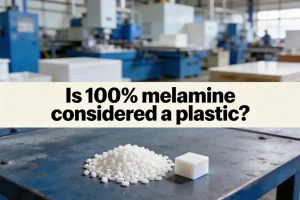
Tech Blog Is 100% Melamine Considered a Plastic? Shoppers, tableware buyers, and material engineers often ask a critical question: Is 100% melamine considered a plastic?

JINGJIANG MELAMINE POWDER
© JINJIANG MELAMINE