

Is melamine flammable?
Tech Blog Is melamine flammable? “Is melamine flammable?” Many people mistakenly classify all plastic-like materials as flammable and worry about fire risks when using or

Urea formaldehyde resin adhesives are the primary adhesives used in the production of engineered wood panels in China and can be applied to bonding units via atomised spraying, roller coating, or immersion coating. The roller coating method is primarily used in the manufacture of plywood. In recent years, with the introduction of the concept of continuous plywood production and its technical implementation, the advantages of the coating-by-immersion process have become increasingly apparent.
Consequently, the preparation and application technology of uf resin adhesives for the flooding process has become a future development direction for modified urea-formaldehyde resins.
As a modified urea formaldehyde resin adhesive for the flooding process, the key requirement is that it maintains good pre-press efficiency and hot-press curing performance even when applied in a low-viscosity state. Based on the application characteristics of modified urea-formaldehyde resin adhesives in plywood production, fillers (typically flour) need to be added during use to increase the solid content of the adhesive, thereby reducing the drainage time required for the subsequent hot-pressing process, improving production efficiency, controlling yield, and ensuring the pre-press forming efficiency of the glued board blanks.
After the modified urea formaldehyde resin adhesive is blended with flour, associative interactions between the components (hydrogen bonds and intermolecular entanglements) tend to increase the viscosity of the adhesive solution. As the standing time increases, the viscosity will rise further.
However, the coating process requires the modified urea formaldehyde resin mixture to possess good flowability, and the rate of viscosity increase must be controlled within a reasonable range over a short period to ensure consistent adhesive application over a specific timeframe. Consequently, the rapid increase in viscosity upon preparation of the modified urea-formaldehyde resin mixture conflicts with the coating process requirements.
As urea formaldehyde resins are water-based, hydrophobic molecules should be introduced to weaken the associative interactions between the adhesive components. Consequently, molecules containing hydrophobic structures commonly used in industrial production have emerged as potential candidates for regulating viscosity reduction in urea formaldehyde resin adhesives. However, to date, no relevant reports have been found on the use of hydrophobic molecules to control the viscosity of urea-formaldehyde resin adhesives.
To explore the feasibility of this hypothesis, this study aims to control the viscosity of the adhesive solution by adding molecules with hydrophobic structures—glycerol trioleate, ethylene glycol oleate, and Tween-80—to weaken intermolecular interactions among the active components.
The study focuses on investigating the effects of the type and dosage of molecules containing hydrophobic structures on the viscosity and rate of increase of the adhesive solution, analysing the mechanisms underlying viscosity reduction and control, and assessing the impact of adding such molecules on the adhesive’s bonding strength.
The aim is to provide a scientific basis and technical reference for the appropriate application of modified urea formaldehyde resin adhesives in plywood production lines utilising the coating method.
Adhesive synthesis raw material: formaldehyde (CAS: 50-00-0, mass fraction of 36.5%~38%), Tianjin Bodi Chemical Co., Ltd. has a new company; Urea (CAS: 57-13-6, analytical grade), Tianjin Zhiyuan Chemical Reagent Co., Ltd; Melamine (CAS: 108-78-1, analytical grade), China National Pharmaceutical Group Chemical Reagent Co., Ltd; Sodium hydroxide (CAS: 1310-73-2, analytical grade), China National Pharmaceutical Group Chemical Reagent Co., Ltd; Formic acid (CAS: 64-18-6, analytical grade), Xilong Science Co., Ltd; Polyvinyl alcohol 17-88 (mass fraction 99.0%), Anhui Wanwei High tech Materials Co., Ltd.
Reagent containing hydrophobic molecules: Glycerol Trioleate (CAS: 122-32-7, mass fraction 99.0%), Aladdin Biochemical Technology Co., Ltd; Ethylene glycol oleate (CAS: 25905-73-1, mass fraction 99.0%), Shanghai McLean Biochemical Technology Co., Ltd; Tween-80 (Polysorbate-80, CAS: 9005-65-6, mass fraction 99.0%), Shanghai McLean Biochemical Technology Co., Ltd.
Packing: High gluten flour (protein 13.8%, fat 1.0%, carbohydrates 71.4%), Xinxiang Xinliang Grain and Oil Processing Co., Ltd.
Eucalyptus spp. veneer: moisture content of 8%~10%, specification size of 300 mm × 300 mm × 2.2 mm.
Adhesive synthesis process
In the adhesive synthesis formula, the ratio of formaldehyde to urea is 1.2:1, and the addition amounts of melamine and polyvinyl alcohol 17-88 are 4% and 0.38% of the adhesive liquid mass, respectively. When synthesizing, first add all formaldehyde in the formula to the reaction kettle, adjust the pH to 8.5 with a 30% sodium hydroxide solution, and then add all polyvinyl alcohol 17-88 and the first-step urea (55% of the total urea in the formula).
After heating to 60 ℃, add the first-step melamine (73% of the total melamine in the formula), heat to 92 ℃, and hold at 92 ℃ for 35 minutes. Subsequently, the temperature was lowered to 85 ℃, and the pH was adjusted to 6.0 with 30% formic acid.
The reaction was carried out until the cloud point, and the mixture was kept at room temperature for 20 minutes. Then adjust the pH value to 6.5, add the second step of melamine (27% of the total amount of melamine in the formula) and the second step of urea (30% of the total amount of urea in the formula), and react until the glue drops into the 25 ℃ water and wire drawing occurs. Immediately adjust the pH value to 6.8-7.0, add the third step urea (10% of the total urea in the formula), incubate and react at 75 ℃ for 30 minutes, add the fourth step urea (5% of the total urea in the formula), adjust the pH value to 7.5-8.0, incubate and react for 15 minutes, cool down and discharge
The viscosity of the prepared melamine-modified urea formaldehyde resin adhesive is 95 mPa·s (25 ℃), the pH is 8.0, the solid content is 61.73%, and the curing time is 150 seconds.
Adhesive Preparation
Mix the synthesized, modified urea formaldehyde resin adhesive with high gluten flour, with flour additions of 5%, 10%, and 15% of the adhesive liquid mass, respectively. Stir until the flour and glue are completely and evenly mixed, without adding any curing agent. Subsequently, take 4 equal parts of the high-viscosity adhesive solution that does not meet the requirements of the glue spraying and sizing process. Add 0%, 0.4%, 0.8%, and 1.6% of the adhesive solution mass containing hydrophobic structural molecules, stir evenly, and set aside for later use.
Preparation of plywood
Prepare three-layer eucalyptus plywood using the prepared adhesive solution. The size is 300 mm × 300 mm. The preparation process parameters are: single-sided glue application amount of 170 g/m2, closed-mouth aging for 1 hour after glue application, cold pressing at 0.8 MPa for 2 hours, hot pressing at 120 ℃, hot pressing at 0.8 MPa, and hot pressing for 10 minutes. Prepare 3 plywood sheets in parallel for each adhesive.
Adhesive viscosity
Test the viscosity of the prepared urea formaldehyde resin adhesive solution at 0, 0.5, 1, 1.5, 2, 2.5, and 5.5 hours, and measure the viscosity at 25 ℃.
Microscopic morphology analysis of adhesive solution
Take 0.1 mL of the sample from the gel prepared with 0% and 1.6% hydrophobic molecules for observation. Drop it onto a glass slide, cover it with a cover slip to evenly distribute the gel, and observe the microstructure under an optical microscope at 200x.
Adhesive strength
Refer to the Class II bonding strength testing method in GB/T 14074-2017 “Testing Methods for Adhesives and Resins Used in the Wood Industry” for testing. Take 12 bonding samples from each plywood for testing, and the average bonding strength of 3 plywood samples under each condition is taken as the final result.
Effects of hydrophobic molecules
Due to the requirement of the glue pouring equipment that the viscosity of the urea formaldehyde resin adhesive should remain stable within the effective process time, no curing agent was used during the glue adjustment in this study to avoid a rapid increase in glue viscosity caused by chemical curing during the glue pouring process. The effects of flour addition and hydrophobic structure molecule addition on adhesive viscosity are shown in Figure 1.
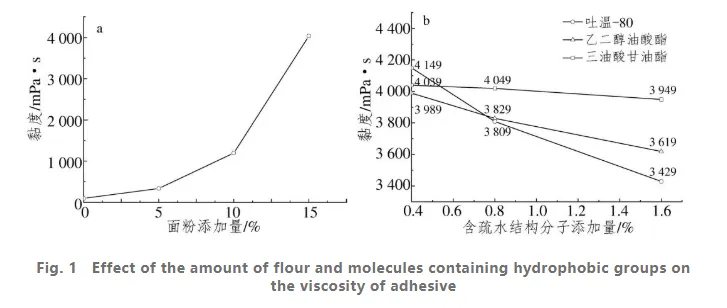
Figure 1a shows that after mixing the modified urea formaldehyde resin with high-gluten flour, the viscosity of the adhesive solution rapidly increases with increasing flour addition. When 15% of the gel’s mass is added as flour, the gel’s viscosity exceeds 4000 mPa · s. Practice has shown that this viscosity can no longer meet the requirements of the glue application process.
According to the previous factory practice, in order to ensure the smooth progress of the glue pouring process and the cold pressing efficiency of the glued slab, the viscosity of the glue should be adjusted to 2500~3500 mPa · s. Therefore, this study will select a flour addition amount of 15% of the gel mass to control the gel’s viscosity, that is, by adding a specified amount of hydrophobic structure molecules.
As shown in Figure 1b, with increasing amounts of hydrophobic molecules added, the viscosity of the adhesive solution decreases. Among them, when ethylene glycol oleate and Tween-80 were added, the viscosity of the adhesive solution decreased significantly. Ethylene glycol oleate and Tween-80 are both non-ionic surfactants containing hydrophobic molecules.
When the addition amount is 1.6%, the viscosity of the adhesive solution decreases from 4039 mPa · s to 3619 and 3429 mPa · s, respectively. The viscosity of the adhesive solution prepared with Tween-80 has decreased by more than 15%, and it meets the requirements for the glue-pouring process. When using glycerol trioleate without a non-ionic surfactant structure, it only shows a certain viscosity-reducing effect when the addition amount is 1.6%
The above results indicate that reducing the viscosity of the modified urea formaldehyde resin and flour blending solution by incorporating hydrophobic structural molecules is effective and feasible. When hydrophobic molecules contain hydrophilic groups (e.g., hydroxyl groups in this study), it is more advantageous to reduce the gel’s viscosity. In fact, similar viscosity-reduction strategies have been validated in the use of dispersed viscosity reducers to reduce the viscosity of heavy oil. Specific structured viscosity reducers penetrate and diffuse between heavy oil gum and asphaltene sheet molecules.
The heterocyclic atoms in the viscosity reducer bind to the gum, reducing the formation of molecular complexes and thus lowering the viscosity of heavy oil. The focus of this study is to prevent intermolecular binding between components in the gel solution.
Although there are differences in the specific principles of action, the viscosity-reduction method for urea formaldehyde resin adhesive solution proposed in this study, based on this idea, is effective as expected.
The impact of storage time
Reducing viscosity improves the adhesive’s dispensing performance, but it is only one of the key goals of adhesive regulation. After mixing modified urea formaldehyde resin adhesive with flour, the viscosity of the adhesive solution will continue to increase with prolonged storage, and its fluidity will decrease accordingly. When the veneer flow speed in the gluing section is fixed, inconsistent gluing amounts occur before and after a certain period, negatively impacting the quality and stability of plywood products.
As the amount of hydrophobic molecules added increases, the relative amount of hydrophobic groups in the molecular structure of the gel increases. This result may weaken the binding between components in the gel, effectively delaying its viscosity increase. Non-ionic surfactants containing hydrophobic molecules are more effective at regulating the viscosity of modified urea-formaldehyde resin adhesives.
Meanwhile, the difference in viscosity control between ethylene glycol oleate and Tween-80 indicates that the hydrophilic end structure of hydrophobic molecules in non-ionic surfactants can also affect viscosity control in the adhesive solution. When the viscosity of the adhesive solution decreases and there is no significant change over a short period, it can ensure the efficiency of glue spraying and the uniformity of glue application during this period, thereby stabilizing subsequent cold/hot pressing processes and product quality.
To clarify the reasons for viscosity reduction and control in the formulation of modified urea formaldehyde resin adhesive solution, this study analyzed the microstructure of the adhesive solution with different hydrophobic structure molecules added. When preparing the adhesive solution, add 1.6% hydrophobic molecules by mass to the mixture of modified urea formaldehyde resin and flour (15% of the adhesive solution).
The components in the adhesive solution, lacking hydrophobic structure molecules, are tightly intertwined and wrapped around one another. After adding hydrophobic structure molecules, the degree of wrapping and entanglement between the components of the adhesive solution is reduced. A significant amount of hydrophobic aggregated particles was found in the gel solution with added triglycerides. The possible reason is that triglycerides are poorly soluble in the gel solution, leading to agglomerated particles during mechanical dispersion.
After mixing modified urea formaldehyde resin with flour, the components form binding interactions through hydrogen bonding and intermolecular entanglements, resulting in a certain viscosity of the adhesive solution. As the protein and starch components in flour gradually unfold in the gel, the binding effect between modified urea formaldehyde resin and flour components gradually increases, and the viscosity of the gel rapidly increases.
After the addition of hydrophobic structure molecules, they are dispersed in a specific form within the gel system, which, to some extent, blocks physical contact between the main gel components, thereby weakening the binding between them and reducing the gel’s viscosity. For non-ionic surfactants, the hydrophilic end of their molecular structure can ensure uniform and efficient embedding in the gel binding system, thereby driving the hydrophobic end to disperse uniformly within the gel system and achieving efficient viscosity reduction.
During the placement of the urea formaldehyde resin adhesive solution, the hydrophobic groups in the system continuously slow the formation rate of hydrogen bonds and physical entanglements between its components, thereby slowing the rate of viscosity increase. In addition, according to the above analysis, when the hydrophilic end content in the molecular structure is appropriately increased, it is beneficial for improving the viscosity-reducing effect.
However, when hydrophobic molecules lack hydrophilic functional groups, their dispersibility in the gel solution is relatively poor, resulting in a weaker viscosity-reducing effect in the blended gel compared to non-ionic surfactants. Similar viscosity-reduction mechanisms have been confirmed in the petrochemical industry and have been used to guide practical applications.
The above analysis confirms that non-ionic surfactants containing hydrophobic molecules effectively control the viscosity of the adhesive solution. However, the adhesive’s bonding strength to plywood is one of its core properties, and controlling the viscosity of the adhesive solution also requires maintaining that strength. Changes in adhesive formulation may affect its bonding performance.
This study selected only two types of non-ionic surfactants as representatives, but, in principle, the mechanism by which most non-ionic surfactants reduce the viscosity of the adhesive is similar. When using non-ionic surfactants to control adhesive viscosity, the effect on bonding strength should also be considered, and the appropriate amount of surfactant should be selected.
The structures of different non-ionic surfactants differ, so their performance in reducing adhesive viscosity and their impact on bonding strength also vary. It is necessary to screen and optimize the addition amount of different non-ionic surfactants in subsequent research.
This study selected three hydrophobic molecules, namely ethylene glycol oleate, triolein glycerol ester, and Tween-80, as viscosity regulators for the adhesive solution. Hydrophobic molecules can reduce the viscosity and growth rate of urea formaldehyde resin adhesives, which is of great reference significance for the formulation of modified urea formaldehyde adhesives for coating.
Non-ionic surfactants containing hydrophobic molecules exhibit good dispersibility in the gel solution, resulting in better viscosity reduction and control. When the addition amount of Tween-80 is 1.6% of the adhesive mass, the viscosity of the adhesive decreases from 4039 mPa · s to 3429 mPa · s, and the average growth rate of the adhesive viscosity decreases from 358 mPa · s/h to 96 mPa · s/h.
This can meet the requirements of the glue application process and provide a scientific basis for upgrading the application technology of urea-formaldehyde glue in the glue production line.
Tech Blog Is melamine flammable? “Is melamine flammable?” Many people mistakenly classify all plastic-like materials as flammable and worry about fire risks when using or

Tech Blog Why can’t melamine be microwaved? If you use melamine tableware for home dining, school cafeterias, or restaurant service, you have likely seen the
Tech Blog Is 100% Melamine Considered a Plastic? Shoppers, tableware buyers, and material engineers often ask a critical question: Is 100% melamine considered a plastic?

JINGJIANG MELAMINE POWDER
© JINJIANG MELAMINE