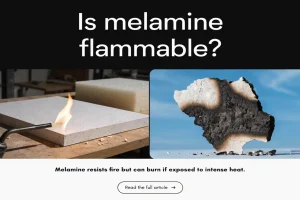

Is melamine flammable?
Tech Blog Is melamine flammable? “Is melamine flammable?” Many people mistakenly classify all plastic-like materials as flammable and worry about fire risks when using or

Epoxy coatings are the most widely used protective materials for carbon steel, marine equipment, machinery, and structural steel, thanks to their outstanding adhesion, chemical resistance, and low cost. However, conventional pure epoxy coatings suffer an unavoidable industry pain point: tiny scratches, impact microcracks, and thermal fatigue fissures easily form during construction & service. Corrosive saltwater, oxygen, and moisture penetrate cracks, directly contact steel substrates, and trigger rust expansion, drastically shortening coating service life and raising frequent maintenance costs.
Intelligent self-healing microcapsule coatings solve this bottleneck via a bionic self-repair principle. When coating cracks rupture, embedded microcapsules release a lauric acid healing agent that flows out, fills microdefects, and re-forms a continuous protective film to block the corrosive medium. Among mainstream microcapsule wall materials, melamine modified urea formaldehyde resin outperforms a single UF shell in terms of higher mechanical strength, lower free formaldehyde emission, excellent acid/alkali tolerance, and lower production cost.
This guide fully covers the in situ polymerization manufacturing process for MUF-lauric acid microcapsules; single-factor optimization of reaction temperature, pH, and core-wall mass ratio; systematic mechanical, salt spray, and electrochemical testing of epoxy coatings loaded with different microcapsule dosages; and provides scalable industrial formulations for paint factories.
| Core-Wall Ratio | Core Content | Encapsulation Rate | Microcapsule Morphology Defect |
| 0.4:1 | 33% | 49.0% | Over-thick shell, low healing agent storage, poor repair capacity |
| 0.6:1 | 76% | 79.3% | Perfect spherical, smooth surface, uniform particle size, no agglomeration |
| 0.8:1 | 66% | 66.7% | Thin fragile shell, easy rupture during coating mixing, serious core leakage |
Optimal core-wall mass ratio = 0.6:1
| Microcapsule Dosage | Hardness | Flexibility Grade | Impact Resistance (kg·cm) | Adhesion (MPa) |
| 0% (Blank) | 2H | 1 | 55 | 4.94 |
| 2% Microcapsules | 2H | 1 | 70 | 4.01 |
| 5% Microcapsules | 2H | 1 | 60 | 2.78 |
Q1: What are the best synthesis parameters for MUF lauric acid self-healing microcapsules?
A: Core-wall mass ratio 0.6:1, reaction temperature 60℃, pH=3, stirring speed 300 r/min, encapsulation rate up to 79.3% with smooth, uniform spherical capsules.
Q2: What microcapsule percentage should be added to epoxy anti-corrosion coating?
A: 2% mass fraction is optimal, balancing self-healing anti-rust performance, coating adhesion, and impact resistance; 5% dosage reduces mechanical strength.
Q3: How does lauric acid microcapsule realize coating self-repair?
A: When scratches break the MUF shell, lauric acid healing agent flows into cracks and forms a continuous hydrophobic isolation film to block oxygen & saltwater, stopping steel corrosion spontaneously.
Q4: Can MUF microcapsule epoxy coating be used for marine steel?
A: Suitable for light marine carbon steel with neutral/alkaline salt fog environment; not recommended for long-term strong acid immersion working conditions.
Q5: Why melamine modified UF instead of single UF as microcapsule wall?
A: MUF shell has higher mechanical toughness, lower formaldehyde release, and better chemical stability, and is less likely to break during coating mixing.
Tech Blog Is melamine flammable? “Is melamine flammable?” Many people mistakenly classify all plastic-like materials as flammable and worry about fire risks when using or
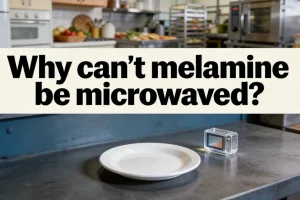
Tech Blog Why can’t melamine be microwaved? If you use melamine tableware for home dining, school cafeterias, or restaurant service, you have likely seen the
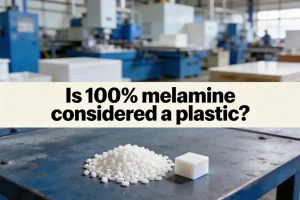
Tech Blog Is 100% Melamine Considered a Plastic? Shoppers, tableware buyers, and material engineers often ask a critical question: Is 100% melamine considered a plastic?

JINGJIANG MELAMINE POWDER
© JINJIANG MELAMINE