

Is melamine flammable?
Tech Blog Is melamine flammable? “Is melamine flammable?” Many people mistakenly classify all plastic-like materials as flammable and worry about fire risks when using or

Urea formaldehyde resin adhesives are the backbone of the wood-based panel industry, valued for their simple synthesis process, low cost, and strong adhesion to lignocellulosic materials. However, their major drawback—high free formaldehyde content and subsequent emission—poses significant environmental and health risks, limiting their use in indoor applications. Modification with melamine has proven to be an effective solution to reduce formaldehyde emissions while maintaining adhesive performance.
Melamine’s unique chemical structure and reactivity address the critical flaw of free formaldehyde in traditional UF resins:
Without melamine modification, UF resins typically have free formaldehyde contents above 0.05%, failing to meet modern eco-friendly requirements.
The molar ratio of formaldehyde to urea directly impacts free formaldehyde content, viscosity, and storage stability (Table 1):
| n(F):n(U) | Viscosity (Pa·s) | Free Formaldehyde Content (%) |
| 1.0 | 0.41 | 0.054 |
| 1.5 | 0.25 | 0.068 |
| 2.5 | 0.19 | 0.093 |
| 3.0 | 0.07 | 0.117 |
| 3.5 | 0.02 | 0.149 |
| Melamine Dosage (% Mass Fraction) | Viscosity (Pa·s) | Free Formaldehyde Content (%) |
| 5 | 0.22 | 0.015 (Lowest) |
| 10 | 0.28 | 0.041 |
| 15 | 0.36 | 0.068 |
| 30 | 0.45 | 0.096 |
Infrared Spectroscopy (FT-IR): The modified resin (UMF) shows no characteristic absorption peaks of melamine at 1551 cm⁻¹ (triazine ring C=N stretching) and 814 cm⁻¹ (triazine ring deformation), confirming melamine has chemically bonded to UF resin chains (not just physically blended).
Thermal Gravimetric Analysis (TGA): The modified resin exhibits four weight loss stages:
1. Room temperature–275℃: Loss of moisture and residual free formaldehyde (14.05% weight loss).
2. 275–375℃: Degradation of polymer side chains (32.36% weight loss).
3. 375–410℃: Breakage of ether bonds in cross-linked networks (23.19% weight loss).
4. 410–600℃: Carbonization of macromolecules (30.40% weight loss).
The TGA results confirm that the modified resin has good thermal stability, making it suitable for high-temperature hot-pressing in wood panel production.
Q1: Can the modified resin be used for outdoor wood panels?
A1: The resin has improved water resistance compared to unmodified UF resin, but is still not recommended for long-term outdoor use (exposed to rain and extreme temperatures). For outdoor applications, further modification with waterproof agents (e.g., polyvinyl alcohol, epoxy resin) or the use of phenol-formaldehyde (PF) resin is recommended.
Q2: How does melamine modification affect production costs?
A2: Melamine (5% dosage) adds approximately 5–8% to raw material costs, but the premium is offset by higher product value (E₀ grade certification) and expanded market access. Additionally, the synthesis process requires no new equipment, minimizing capital investment.
Q3: Is the modified resin compatible with different wood species?
A3: Yes. The resin works well with both softwoods (e.g., pine, poplar) and hardwoods (e.g., birch, oak) due to its balanced viscosity and strong adhesion. For wood with high extractive content (e.g., teak), pre-treatment with ethanol to remove extractives is recommended to avoid adhesion inhibition.
Q4: How to test the free formaldehyde content of the resin?
A4: Use the sodium bisulfite-iodine titration method: React 10g of resin with excess sodium bisulfite, then titrate the unreacted sodium bisulfite with iodine solution. Calculate free formaldehyde content using the formula:
Free formaldehyde (%) = 100 × (V₁ – V₀) × N × 0.03 / W
Where V₁ = sample titration volume, V₀ = blank titration volume, N = iodine solution concentration, W = resin sample mass, 0.03 = formaldehyde molar mass factor.
Melamine modified urea formaldehyde resin address the key limitation of traditional UF resins—high formaldehyde emission—while maintaining cost-effectiveness and process compatibility. With simple synthesis steps, minimal equipment investment, and broad application potential, this modified resin is a game-changer for the wood-based panel industry, enabling manufacturers to produce eco-friendly products that comply with global environmental regulations.
As consumer demand for green building materials grows, melamine-modified UF resin will become the mainstream choice for indoor wood products, balancing performance, cost, and sustainability. For wood panel manufacturers and adhesive formulators, adopting this optimized formulation is a strategic move to enhance product competitiveness and meet evolving market demands.
Tech Blog Is melamine flammable? “Is melamine flammable?” Many people mistakenly classify all plastic-like materials as flammable and worry about fire risks when using or

Tech Blog Why can’t melamine be microwaved? If you use melamine tableware for home dining, school cafeterias, or restaurant service, you have likely seen the
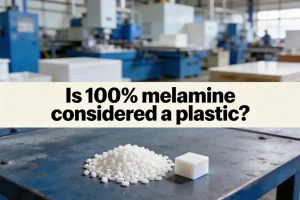
Tech Blog Is 100% Melamine Considered a Plastic? Shoppers, tableware buyers, and material engineers often ask a critical question: Is 100% melamine considered a plastic?

JINGJIANG MELAMINE POWDER
© JINJIANG MELAMINE