jinjiang melamine

Tech Blog

Experimental study on explosion characteristics of wood dust containing urea formaldehyde resin

Wood dust generated from sawing, sanding, and milling plywood, particleboard, and MDF ranks as the second most frequent combustible dust explosion hazard in industrial facilities, only behind metal dust disasters. Over 80% of global wood composite panels use urea formaldehyde resin (UF resin) as a bonding agent, so nearly all workshop dust carries residual UF adhesive particles.

Most prior dust explosion research focused on pure wood fiber dust, with little data covering UF-contaminated wood dust. This guide breaks down authoritative 20L sphere & Hartmann tube test data comparing UF-bonded wood dust (Sample A) vs pure, glue-free wood dust (Sample B), analyzes the explosion suppression effect of UF resin, and delivers factory-ready safety compliance solutions aligned with NFPA 664 & GB/T dust testing standards.

explosion characteristics of wood dust containing urea formaldehyde resin Test Setup & Sample Preparation

Two dust groups were tested under identical lab conditions:
  1. Sample A: Wood dust coated with cured UF adhesive (industrial sanding waste from fiberboard)
  2. Sample B: Pure raw wood dust without any resin binder
  3. All samples were sieved into 150/200/300 mesh fractions and dried to constant weight at 75°C to eliminate moisture interference.

Key Test Equipment

  • MIKE III Hartmann tube: Measure Minimum Ignition Energy (MIE)
  • Constant temperature hot plate: Test dust layer minimum ignition temperature (MITL)
  • Godbert-Greenwald furnace: Dust cloud minimum ignition temperature (MITC)
  • Standard 20L spherical explosion vessel: Lower Explosive Concentration (MEC), max explosion pressure (Pmax), pressure rise rate (dp/dt) & explosion index Kst
  • MIKE III & 20L Explosion Test Devices

Microscopic & Element Differences Between Two Dust Types

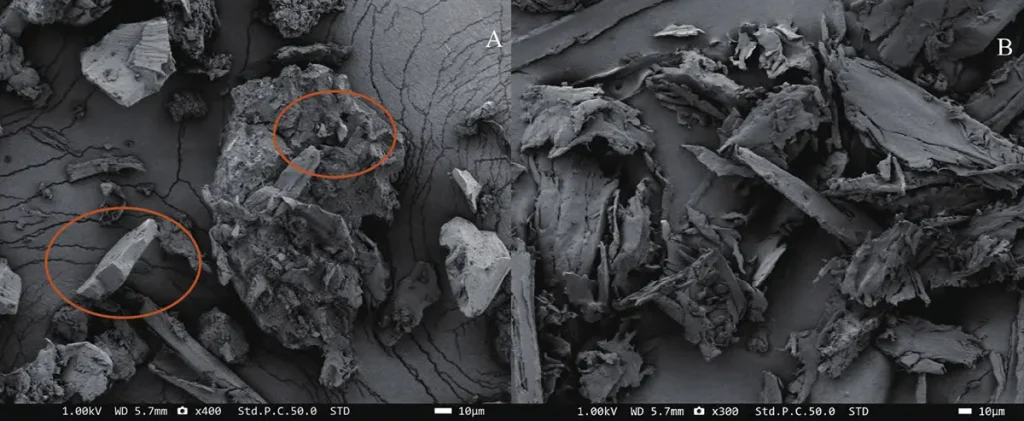
SEM imaging confirms UF resin forms rough agglomerate coatings on Sample A wood particles, creating physical barriers between fiber and oxygen.

SEM of A2 (UF dust) & B2 (pure wood dust)
Element analysis highlights core differences:
  • Sample A (UF dust): Nitrogen 4.21% (from urea), higher ash content (2.31%)
  • Sample B (pure wood): Nitrogen only 0.35%, lower fixed carbon residue
TG-DTG thermal tests show UF dust decomposes more slowly: its peak thermal weight-loss rate shifts to a higher temperature, with higher residual char after full combustion, slowing chain combustion reactions.
Electron microscopy images of dust samples

Key Explosion Sensitivity Test Results (200 Mesh Standard A2/B2 Samples)

All critical ignition metrics prove UF adhesive reduces wood dust flammability & explosion sensitivity:

Dust Layer Minimum Ignition Temperature (MITL)

Dust layer thickness directly lowers ignition temperature due to trapped heat buildup. At 15mm thickness:
  • UF bonded dust (A₂): 310°C
  • Pure wood dust (B₂): 295°C
  • At every tested thickness (5/12.5/15mm), Sample A requires a higher surface temperature to self-ignite. UF crosslinked char film insulates wood fibers from heat and oxygen contact, delaying spontaneous combustion.

Dust Cloud Minimum Ignition Temperature (MITC)

Under optimal 70kPa spray pressure for uniform dust cloud dispersion:
  • A₂ MITC: Above 450°C
  • B₂ MITC: Below 450°C
  • UF releases inert gases (NH₃, CO₂) during early heating, diluting flammable volatiles released by cellulose and raising the cloud ignition threshold.

Minimum Ignition Energy (MIE) at Optimal 1250g/m³ Concentration

MIE is the smallest spark energy to trigger a dust explosion:
  • UF wood dust A₂: 100 ~ 150 mJ
  • Pure wood dust B₂: 50 ~ 100 mJ
  • UF resin coating reduces particle-specific surface area and suppresses free radical chain reactions, requiring far stronger sparks to ignite dust clouds.

Lower Explosion Limit (MEC)

Minimum airborne dust density capable of explosion:
  • A₂ (UF bonded): 125 g/m³
  • B₂ (pure wood): 75 g/m³
  • UF inert pyrolysis gases raise the critical concentration needed to form a flammable dust-air mixture, lowering daily explosion risk in lightly dusty workshops.

Explosion Severity Data: UF Resin Weakens Blast Force

Explosion intensity metrics (Pmax, dp/dt, Kst explosion index) quantify blast damage potential within a 200–1500 g/m³ concentration range:

Maximum explosion pressure (Pmax)

  • A₂: 0.67 MPa
  • B₂: 0.78 MPa

Maximum pressure rise rate (dp/dt max)

  • A₂: 26.96 MPa/s
  • B₂: 21.75 MPa/s

Explosion Index Kst (all samples fall into St1 weak explosive grade, 0 < Kst ≤ 20 MPa·m/s)

  • Peak Kst for A series: 7.32 MPa·m/s
  • Peak Kst for B series: 8.62 MPa·m/s

Why UF Suppresses Explosion Violence

  1. Early UF thermal decomposition releases non-flammable NH₃, HNCO, and CO₂ to dilute oxygen and quench combustion free radicals.
  2. Higher ash content absorbs explosion heat and blocks flame propagation.
  3. Crosslinked carbon film forms a physical barrier on wood particles, slowing oxidation reaction rates.
  4. UF agglomeration reduces dust specific surface area, limiting contact between cellulose volatiles and air.

Core Influencing Factors on UF Wood Dust Explosion Risk

Dust Particle Size (Critical Safety Factor)

Finer dust (higher mesh count = smaller D50 particle size):
  • Lower MITC & MEC (easier to ignite)
  • Higher Pmax & Kst (more powerful explosion)
  • 300-mesh ultra-fine sanding dust poses the highest hazard for both pure and UF bonded wood waste, as ultra-small particles maximize surface area for rapid combustion.

Dust Cloud Concentration

All dust types follow the same trend: ignition energy falls, explosion force rises to a peak at ~1250 g/m³, then declines at over-saturated high concentrations. Excess dust particles absorb heat and restrict oxygen access, slowing blast reaction speed.

UF Resin Content

Higher residual UF on wood fibers consistently improves fire resistance across all test indicators, but UF only reduces risk — it does NOT eliminate explosion hazards entirely. Even St1 grade weak dust can trigger destructive secondary explosions in poorly ventilated, unclean factories.

Industrial Safety Recommendations for Wood Composite Plants

Even with UF’s natural explosion suppression effect, plywood/MDF/particleboard facilities must implement full dust control protocols aligned with NFPA 664 and ATEX standards:

Eliminate Dust Accumulation (Primary Prevention)

  • Daily vacuum cleaning of horizontal surfaces; restrict loose sweeping that creates suspended dust clouds;
  • Control dust layer thickness under 0.5mm to avoid self-heating ignition;
  • Install fully enclosed dust extraction hoods on sanders, planers, saws to stop fugitive dust spread.

Eliminate All Ignition Sources

  • Ground all machinery, dust pipes and collection tanks to eliminate static sparks;
  • Install spark detection & extinguishing systems on dust ductwork to catch hot wood particles from friction;
  • Separate high-temperature hot press equipment from sanding dust zones; maintain surface temperatures below 300°C.

Dust Collector Safety Design

  • Equip baghouses with explosion vent panels, isolation valves, and rotary airlock discharge valves to block flame backpropagation;
  • Maintain negative pressure inside dust collection systems to prevent dust leakage into workshop air;
  • Regular moisture testing of collected dust; dry ultra-fine dust amplifies explosion risk drastically.

Process Optimization to Lower Explosion Hazard

  • Limit production of 300-mesh ultra-fine sanding dust where feasible.
  • Add controlled moisture to wood stock to raise dust minimum ignition energy.
  • Prioritize low-F/U modified UF adhesives with higher char-forming performance for extra fire suppression.

Emergency Mitigation

  • Classify workshop zones per dust explosion risk; install fire suppression systems in dust collection rooms.
  • Train staff on secondary explosion risks: a small primary blast can stir accumulated dust into a deadly larger explosion.

FAQ

Q1 Does urea-formaldehyde glue completely prevent wood dust explosions?

A: No. UF resin only suppresses ignition sensitivity and blast intensity; all UF-bonded wood dust still ranks as St1 weak explosive dust. Full dust management safety systems remain mandatory for all wood processing facilities.

Q2 What is the most dangerous dust concentration for MDF sanding waste?

A: 1250 g/m³ airborne dust delivers the lowest ignition energy and maximum explosion pressure for both pure and UF-coated wood particles. Factories must maintain ventilation to keep dust density far below this threshold.

Q3 How much hotter does UF wood dust need to self-ignite compared to clean wood dust?

A: At a standard 15mm dust layer thickness, UF bonded dust ignites at 310°C vs 295°C for pure wood, a 15°C higher critical temperature threshold for spontaneous combustion.
 

Related Blogs

Jinjiang chemical

Contact Us to Start Your Business