
jinjiang melamine

Tech Blog

Effect of Latency Curing Agent on Amino Moulding Plastic Properties

Amino resins include urea formaldehyde resin and melamine resin, which are respectively obtained by the condensation reaction of urea and formaldehyde, melamine and formaldehyde in the presence of a curing agent.

Urea formaldehyde molding compounds are generally made with urea formaldehyde resin as the matrix, and various fillers, cellulose, curing agents, lubricants, release agents, and pigments are added during kneading. The products are then dried, crushed, ball milled, and sieved.

Urea formaldehyde resin, a downstream product of the coal chemical industry, offers low cost, rapid curing, excellent product coloring, and low flammability, making it the most widely used amino resin.

However, after the production of urea formaldehyde molding compounds into powder, because the curing agent is added during the kneading process and has already started pre-polymerization, during transportation and sealed storage, urea formaldehyde molding compounds have to face a large amount of heat generated by climate and product accumulation, which leads to temperatures much higher than room temperature, making them prone to problems such as solidification agglomeration, formation of dead materials, or decreased processing performance.

However, because of the current low curing temperature, it is prone to premature curing in high-temperature screws, limiting its development and application in extrusion molding. Therefore, this study investigated the effects of two synthesized series of curing agents on the molding temperature and curing product properties of urea formaldehyde molding compounds.

Effect of Latency Curing Agent on Amino Moulding Plastic Properties Experimental section

Raw materials

Formaldehyde; urea; wood pulp paper; ammonium chloride; and phthalic acid compound curing agent (marked as CB below), industrial grade.

Experimental equipment

Reaction kettle; Kneading machine; Drying oven, WH40; Ceramic jar ball mill; Flat press machine, Y71-40T; Simply supported beam impact testing machine; Differential Scanning Calorimeter (DSC), DSC204F1; Hot deformation Vicat temperature tester, MZ-2030B; Electronic universal testing machine, MZ-5000D1.

Test Method

Synthesis of curing agent

Prepare a curing agent with a solid content of about 45%: strong acid ① and strong acid ② react with weak bases a, b, c, d, and e in a 1:1 ratio to synthesize two series of curing agents, labeled as the first series ① a, ① b, ① c, ① d, and ① e;

The second series includes ②a, ②b, ②c, ②d, and ②e. Among them, ① is para-aminobenzenesulfonic acid, and ② is para-aminobenzenesulfonic acid

Methyl benzenesulfonic acid, a is ethanolamine, b is diethanolamine, c is methylamine, d is dimethylamine, and e is trimethylamine.

Synthesis of Urea Formaldehyde Resin

Formaldehyde and urea are mixed in a molar ratio of 1.0:1.4, and hexamethylenetetramine and urea are mixed in a three-necked flask at a mass ratio of 1:23. The temperature is raised to 60 ℃ within 1 hour and held at that temperature for 1 hour to obtain urea-formaldehyde resin.

Preparation of Urea Formaldehyde Molding Materials

Load 2000g of resin into a kneading machine, add wood pulp paper, curing agent, and release agent (zinc stearate), knead at 60-70 ℃ for 40 minutes, and dry in an oven at 85-90 ℃ for 2 hours to completely evaporate volatile small molecules. Grind, then ball mill, for 5 hours to obtain urea-formaldehyde molding compound powder.

Performance Testing

(1) Determination of the amount of curing agent added and the molding temperature and time. Change the amount of curing agent added during kneading to produce powder. Place an appropriate amount of sample into a preheated disc mold at a certain temperature. After a specified pressure and time, take out the cured disc sample and observe its curing and forming condition. Visually inspect the surface for smoothness and flatness, and check for bubbles, cracks, impurities, etc.

(2) Add a certain amount of curing agent to the resin and test it in DSC. Observe the heat release in the spectrum and the curing reaction
The peak temperature and temperature range. Testing conditions are: heating rate of 10 ℃/min, heating range of 50-160 ℃, and a nitrogen flow rate of 50mL/min.

(3) Mechanical performance analysis of compressed sample preparation. Bending performance shall be tested according to GB/T9341-2008; The impact strength shall be tested according to GB/T1451-2005; The hot deformation temperature shall be tested according to GB/T1634.2.

Results and discussion

To ensure good appearance and mechanical properties, the curing agent used for urea formaldehyde molding plastics mainly considers curing time, curing temperature, and flowability. The two curing agent series are neutral to alkaline at room temperature and rapidly release acid at high temperatures, providing an acidic environment for curing and crosslinking of urea formaldehyde molding compounds. The curing agent selection should be based on the relationship between curing rate and flowability, molding process conditions, stability during the production of urea formaldehyde molding plastics, and the manufacturer’s usage requirements.

Analysis of curing agent dosage

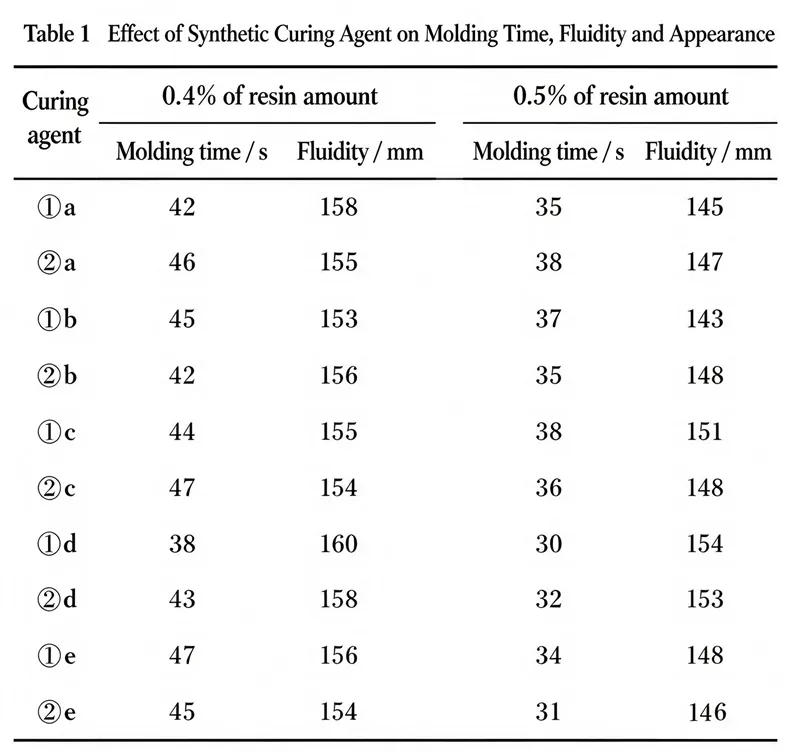
The current dosage of curing agent CB is 0.4% of the mass of urea formaldehyde resin. The molding temperature is 145 ℃ for the lower mold and 155 ℃ for the upper mold, with a molding time of 25 seconds. The flowability is represented by the diameter of the pressed disc, which is 150mm. The disc has a smooth, flat appearance, with no fog, bubbles, or cracks. The effect of the amount of synthetic curing agent added on the molding time and flowability of urea formaldehyde resin is shown in Table 1.

When the curing agent is added at 0.3% of the mass of urea formaldehyde resin, curing is incomplete, and the urea formaldehyde powder remains partially dispersed, forming a crosslinked grid structure without a condensation reaction, so it cannot be formed. When the curing agent dosage increases to 0.4% of the mass of urea formaldehyde resin, the molding time increases, flowability improves, and fog blocks and bubbles appear on the surface of the disc, resulting in defects. This is due to insufficient curing agent, so the released acid cannot fully cure the urea-formaldehyde molding material in a short period of time.

When the curing agent dosage is increased to 0.5% of the mass of urea-formaldehyde resin, the disc forms well, with a smooth, clean surface, and achieves the same appearance as production products. The longer molding time is due to the high-temperature latent nature of the prepared curing agent, which slows acid release at the same mold temperature as CB. Increasing the mold temperature can reduce the molding time of the synthesized curing agent to meet processing requirements.

TABLE 1

DSC analysis

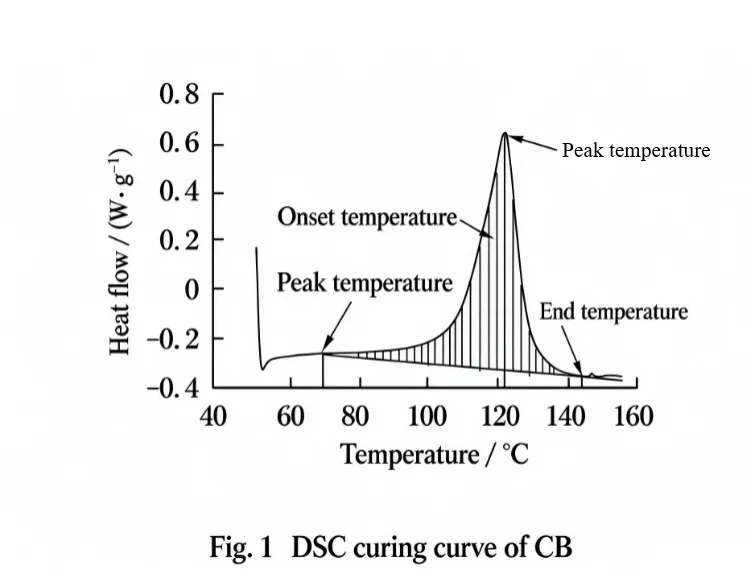
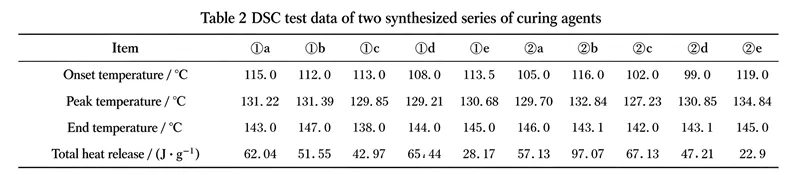
Synthesize the resin according to the ratio in 1.3.2, and add the curing agent at 0.5% of the urea-formaldehyde resin mass. The DSC test results are shown in Figure 1 and Table 2.

FIG 1

This experiment mainly investigates the curing reaction temperature range. Below 60 ℃, no exothermic effect is observed. As the temperature increases, the curing agent begins to release acid, and the curing reaction slowly accelerates. At the curing agent’s peak temperature, the reaction rate reaches its maximum. Then, as the urea-formaldehyde resin cures and the acid concentration decreases, the reaction slows and stops.

From the DSC curve of curing agent CB in Figure 1, it can be seen that the starting temperature of the curing agent CB currently used is around 70 ℃, the peak temperature is 121.4 ℃, and the reaction end temperature is 145.0 ℃. Integrating it yields a total heat release of 76.72 J/g. The DSC test data for the two synthesized series of curing agents are shown in Table 2.

Tab 2

Compared with the DSC of curing agent CB, the two synthesized series of latent curing agents show significantly higher initial acid-release temperatures and peak temperatures than CB’s 70 ℃ and 121.4 ℃, respectively, with little change in the reaction termination temperature. This also indicates that the initial temperature at which the synthesized curing agent releases acid for curing has significantly increased, and the temperature at which its maximum curing reaction rate occurs has also increased by about 10 ℃.

By increasing the molding temperature, the problem of slow solidification and the formation of lumps and dead materials caused by high temperature during the storage and transportation of urea formaldehyde molding plastics has been solved, extending the shelf life of urea formaldehyde molding plastics.

According to the data in Table 2, the first series of curing agents: starting temperature ① a>① e>① c>① b>① d, terminated
Temperature ① b>① e>① d>① a>① c, peak temperature ① b>① a>① e>① c>① d, total heat release ① d>① a>① b>① c>① e. The second series of curing agents: starting temperature ② e>② b>② a>② c>② d, ending temperature ② a>② e>② b>② d>② c, peak temperature ② e>② b>② d>② a>② c, total heat release ② b>② c>② a>② d>② e.

Based on the above data and tablet appearance, ① a in the first series and ② b in the second series are the most ideal latent high-temperature curing agents in these two series, while maintaining the same appearance as the CB curing agent.

Mechanical Performance Analysis

Press the urea-formaldehyde resin with CB and the synthesized curing agents ① a and ② b separately at a lower mold temperature of 145 ℃ and an upper mold temperature of 155 ℃, and at a mold temperature of 155 ℃ and an upper mold temperature of 165 ℃. The results showed that as the temperature increased, the molding time of curing agents ① a and ② b shortened. However, during compression, the resin exhaust of curing agent ① a increased, and irritating odors were released. The extruded sample was light yellow and had poor transparency, which affected processing and application of amino molding plastics in the next coloring step. The transparency and appearance of the ② b curing agent resin tablet are consistent with those of the CB curing agent resin tablet.

Conclusion

To achieve the same curing effect as the current compound curing agent CB (ammonium chloride and phthalic acid), the optimal dosage is 0.5% of the urea-formaldehyde resin mass, an increase compared with the CB dosage.

Compared with CB, the curing-start temperature for both curing-agent series increased by nearly 30 ℃. The peak temperature has increased by about 10 ℃. This improves the flowability of urea-formaldehyde molding compounds during storage and transportation.

Considering the curing characteristics, molding appearance, and mechanical properties of the pressed samples, the best choice between the two curing-agent series is ② b.

Related Blogs

Melamine Fiber Modification
Jinjiang

Melamine Fiber Modification

Tech Blog Melamine Fiber Modification Melamine‑formaldehyde fiber (MF fiber, commercial-grade Basofil) is a well‑known, halogen‑free, high‑performance flame‑retardant fiber. It has no melt‑drip performance, excellent high‑temperature

Read More »

Jinjiang chemical

Contact Us to Start Your Business