jinjiang melamine

Tech Blog

Is Melamine-Formaldehyde Brittle?

Melamine-formaldehyde resin is a widely used thermosetting polymer for tableware, decorative laminates, electrical components, and industrial coatings. Although it is known for its high hardness, heat resistance, and chemical stability, unmodified MF resin has inherent mechanical limitations. So many people often ask, “Is Melamine-Formaldehyde Brittle?”

This article clarifies the brittleness of melamine-formaldehyde resin, analyzes the root chemical causes, compares performance differences across products, and shares practical toughening modification solutions for industrial production.

Is Melamine-Formaldehyde Brittle?

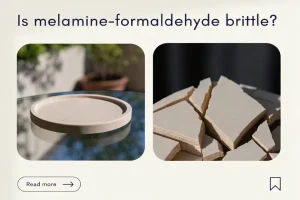
Pure, unmodified cured melamine-formaldehyde resin is inherently brittle. Its highly cross-linked rigid molecular structure delivers exceptional surface hardness, scratch resistance, and dimensional stability, but sacrifices toughness. Unmodified MF resin cracks or fractures under sudden impact, bending force, or repeated mechanical loading, which is the most typical drawback of traditional MF materials.

However, commercial-grade MF products (melamine moulding compounds, laminates, tableware) are less brittle. Industrial formulations add toughening fillers, flexible modifiers, and cellulose reinforcements to balance hardness and toughness, effectively reducing brittleness and meeting daily and commercial usage requirements.

Why Is Melamine-Formaldehyde Inherently Brittle?

The brittleness of MF resin stems from its unique molecular structure and thermosetting curing characteristics, which cannot be eliminated in pure resin systems:
  • Rigid triazine ring molecular skeleton: MF resin is polymerized from melamine, which contains stable triazine ring structures. After curing, the molecular chains form a dense, rigid, three-dimensional cross-linked network with almost no flexible deformation space. When impacted, the material cannot absorb energy through bending or stretching, leading to direct molecular bond fracture and cracking.
  • High cross-link density: The full cross-linking reaction of melamine and formaldehyde creates a tight network structure. Higher cross-linking density improves hardness and heat resistance but further increases material rigidity and brittleness.
  • Stress concentration effect: Pure MF resin has poor stress dispersion ability. Tiny internal defects or external impact force will concentrate on local molecular bonds, causing rapid crack propagation and brittle fracture.
Test data show that unmodified MF resin has low notched Izod impact strength, confirming its typical brittle thermoset properties.

Brittleness Differences Across MF-Based Products

Not all melamine-formaldehyde products have the same brittleness. Product performance varies greatly based on formulation, fillers, and processing technology:

Pure MF Resin Castings & Coatings

Pure cured MF resin coatings and cast blocks are the most brittle. They are prone to cracking under slight impact or temperature changes, so pure MF resin is rarely used alone in industrial end products.

Standard Melamine Moulding Compound (MMC) & Tableware

Food-grade melamine moulding compound adds α-cellulose as a reinforcing and toughening filler. Cellulose fibers disperse internal stress and block crack propagation, greatly improving toughness. Finished melamine tableware is shatter-resistant in daily use and far less brittle than pure MF resin, though still less flexible than plastic or rubber.

MF-Impregnated Decorative Laminates

MF resin-impregnated paper for furniture panels and flooring is moderately brittle. Long-term dry environments or external impact may cause surface cracking, which is why modified flexible MF resin is widely used in high-grade decorative materials.

Melamine Foam

Melamine foam has an open-cell porous structure. While lightweight and sound-absorbent, it retains inherent MF brittleness and is prone to powdering and fragmentation under friction or extrusion, limiting its use in high-friction scenarios.

MF Resin vs. UF Resin: Which Is Less Brittle?

Most buyers confuse melamine-formaldehyde resin with urea-formaldehyde (UF) resin. Here is a clear toughness and brittleness comparison:
  • Brittleness: Pure MF resin < Pure UF resin. Melamine-formaldehyde has better molecular stability and is less brittle than urea-formaldehyde resin.
  • Toughness & durability: Modified MF products have stronger impact resistance, better water resistance, and greater thermal stability than UF products, making them better suited for demanding applications.
  • Application difference: High-toughness MF materials are used for high-standard tableware and laminates, while brittle UF materials are suitable only for low-demand, non-food decorative parts.

Industrial Solutions to Reduce MF Brittleness

To address the inherent brittleness of melamine-formaldehyde resin, manufacturers use mature modification technologies to improve toughness without sacrificing hardness and heat resistance.
  • Flexible polymer modification: Add PVA (polyvinyl alcohol), ethylene glycol, or dialdehyde starch to introduce flexible molecular chains, optimize cross-linking structure, and enhance deformation resistance.
  • Fiber reinforcement: Mix cellulose fiber, glass fiber, or inorganic fillers to disperse stress and inhibit crack expansion.
  • Molar ratio adjustment: Optimize the formaldehyde-melamine molar ratio to reduce excessive cross-linking density and balance rigidity and toughness.
  • Hyperbranched polysiloxane modification: Introduce a flexible Si-O-C skeleton structure to greatly improve the toughness of MF-impregnated paper and coatings, avoiding cracking and peeling.

Practical Application Tips for Brittle MF Materials

  • Avoid using unmodified pure MF resin for impact-prone parts; choose modified toughened MMC for tableware and daily-use products.
  • Prevent long-term exposure to extreme dry or high-temperature environments to reduce brittle cracking of MF laminates and coatings.
  • Control molding curing parameters to avoid over-curing, which increases cross-link density and worsens brittleness.
  • Do not use MF products for bending or frequent extrusion scenarios to prevent fatigue cracking.

FAQs

Q1: Is melamine-formaldehyde brittle?

Pure, unmodified melamine-formaldehyde resin is inherently brittle because of its rigid, highly cross-linked molecular structure. However, industrial modified MF products (toughened MMC tableware, filled laminates) have significantly reduced brittleness with good impact resistance for daily commercial use.

Q2: Why is melamine formaldehyde resin brittle?

Its brittleness comes from the stable, rigid triazine ring structure and dense three-dimensional cross-linked network. The material cannot deform or absorb impact energy, so external force causes direct bond fracture and cracking.

Q3: Is melamine tableware brittle and easy to break?

No. Food-grade melamine tableware is made of cellulose-toughened MMC. Compared with pure MF resin, it has excellent shatter resistance, is not easy to break in daily use, and is far more durable than brittle ceramic in collision scenarios.

Q4: Which is more brittle, MF or UF resin?

UF (urea-formaldehyde) resin is more brittle than MF resin. Modified MF materials have better toughness, water resistance, and stability, making them the preferred material for high-quality tableware and decorative panels.

Q5: How to improve the brittleness of melamine-formaldehyde resin?

Common industrial methods include adding flexible modifiers like PVA, mixing fiber reinforcements, adjusting resin molar ratio, and adopting polysiloxane toughening technology to balance hardness and toughness.

conclusion

To answer the core question: Is melamine-formaldehyde brittle? Pure melamine-formaldehyde resin is inherently brittle because its rigid, highly cross-linked molecular structure is an unavoidable characteristic of unmodified thermoset MF materials. Nevertheless, through professional toughening modification, filler compounding, and formula optimization, commercial MF products such as melamine moulding compounds, tableware, and decorative laminates effectively overcome brittleness defects.

Understanding the brittleness mechanism and modification solutions of melamine-formaldehyde resin helps manufacturers select suitable resin grades, optimize production formulas, and avoid cracking and fragmentation problems in finished products, ensuring stable quality of tableware, decorative materials, and electrical insulating parts.

Related Blogs

Is Melamine-Formaldehyde Brittle?
Jinjiang

Is Melamine-Formaldehyde Brittle?

Tech Blog Is Melamine-Formaldehyde Brittle? Melamine-formaldehyde resin is a widely used thermosetting polymer for tableware, decorative laminates, electrical components, and industrial coatings. Although it is

Read More »
Is melamine synthetic?
Jinjiang

Is melamine synthetic?

Tech Blog Is melamine synthetic? Is melamine synthetic? None of these substances occur freely in nature. Every commercial form of melamine‑based material is artificial via

Read More »

Jinjiang chemical

Contact Us to Start Your Business