
jinjiang melamine

Tech Blog

Low-temperature synthesis method of environmentally friendly urea formaldehyde resin adhesive

Urea formaldehyde resin is the most important adhesive in the wood processing industry both domestically and internationally, also known as urea formaldehyde adhesive. Urea formaldehyde resin is a low molecular weight resin produced by the addition and condensation reactions of urea and formaldehyde under the action of a catalyst. When used, curing agents and additives are added to make a foaming agent; In addition to slightly poor water resistance and durability, there are many advantages, such as easy availability of raw materials, low cost, colorless or milky white resin, high transparency after curing, no pollution to the surface of wood, simple process, and low cost.
However, formaldehyde resin contains relatively high free formaldehyde. As living standards improve and environmental awareness grows, the harm excessive formaldehyde can cause to the body and mind has attracted increasing attention.

This article achieves resin synthesis by controlling the formaldehyde ratio, using a secondary condensation process, and adding formaldehyde-capture agents under strong acidity and low- to medium-temperature conditions, thereby reducing free formaldehyde content in formaldehyde resin. It also reduces energy consumption.

The synthesis mechanism of urea formaldehyde resin

Urea is easily soluble in water, prone to moisture absorption and clumping, and is not very stable in water, dilute acid, and dilute alkali. Therefore, the synthesis reaction of urea formaldehyde resin is theoretically divided into two stages. Firstly, formaldehyde and urea undergo an addition reaction under weakly alkaline conditions to generate a light methyl vein:

Many factors in urea-formaldehyde resin synthesis, such as the molar ratio of raw material components, reaction pH, reaction temperature, and reaction time, can directly affect the product’s performance and quality. Resin with the same molar ratio is fed in batches with urea, improving overall performance and reducing free formaldehyde.

Experimental section

Experimental raw materials

Urea (industrial grade); Formaldehyde (analytical grade, 37%- 40%), sodium hydroxide (analytical grade), PVA(1799), melamine, NH4Cl, Sodium carboxymethyl cellulose, hydrochloric acid (analytical grade), hydrochloric acid with amine (analytical grade), anhydrous ethanol (analytical grade), and thymol blue indicator.

Experimental Equipment

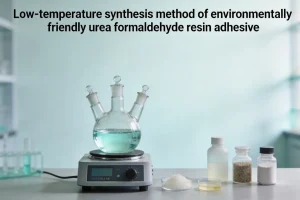
JJ-1 timed electric mixer, digital constant temperature water bath, precision pH meter, three-necked flask, thermometer, burette, volumetric flask, etc.

Experimental steps

  1. Polyvinyl alcohol (PVA) is added to boiling water and processed into a uniform viscous paste.
  2. Add 37% formaldehyde solution 54nd to a three-necked flask equipped with a thermometer, reflux condenser, and stirrer; adjust the pH value between 7.7 and 8.2 with 30% sodium hydroxide solution, add 28.9 grams of urea, start the stirrer, heat to around 50 ℃ for reaction, and add 0.5 grams of pre-treated PVA after 6 minutes of reaction.
  3. Heat to 7090 within 30 minutes, add 3.4 grams of the second batch of urea, keep warm, and finally add 1.7 grams of urea. React for 40 minutes, stop heating, and reduce the temperature to 53 ℃.
  4. Adjust the system pH to 4-4.5 and allow it to react until the endpoint.
  5. Adjust the pH value between 7.7 and 8.3 with a 30% sodium hydroxide solution, add 0.6 grams of melamine and a small amount of sodium methylcellulose, continue stirring for 20 minutes, and let it cool naturally to room temperature before discharging.

Determination of free formaldehyde

Accurately weigh about 1.5 grams of urea formaldehyde resin adhesive in a triangular flask, heat slightly, shake gently for 1-2 minutes, then add 3-4 drops of sniffing thymol blue indicator and shake well. Adjust the color to yellow-green with dilute hydrochloric acid solution, add 15ml of 10% hydrochloric acid amine solution, shake well, and titrate with NaOH standard solution until the solution turns blue-green. If it does not change color within half a minute, the endpoint is reached.

Results and Discussion

Overview of the use of formaldehyde capture agents

Formaldehyde capture agents, also known as deodorizers or formaldehyde binders, are mainly characterized by their ability to react chemically with formaldehyde under certain conditions to form a new stable substance or absorb formaldehyde. Commonly used substances include urea, melamine, phenol, polyvinyl alcohol, p-toluenesulfonylamide, bark powder, flour, resorcinol, and peroxysulfide.

Urea is the most commonly used type, usually added later on, but excessive addition can affect product quality. Some use a mixture of water-based phenolic resin, sulfonamide acid, urea mold, and other materials to form a formaldehyde scavenger. Some people also add an appropriate amount of oxidant later in the formaldehyde reaction to oxidize residual formaldehyde into formic acid, reducing formaldehyde content to below 0.5%.

The influence of molar ratio on the content and properties of free formaldehyde in urea formaldehyde resin

The molar ratio is an important factor affecting formaldehyde release from formaldehyde resin adhesives, and increasing the molar ratio (F/U) significantly increases the board’s formaldehyde emission. The molar ratio (F/U) of formaldehyde to urea in the initial use of formaldehyde resin adhesive for artificial boards was between 2.2 and 2.5, but has now decreased to 1.05. When the F/U ratio decreases from 1.8 to 1.3, the formaldehyde release decreases by 2/3.

Reducing F/U decreases free formaldehyde and methyl groups, altering adhesive-solution properties by reducing viscosity and water solubility, and affecting its activity and stability. Therefore, this experiment adopts a formaldehyde/urea molar ratio of 1.3:1.

Effect of PVA dosage on the performance of urea formaldehyde resin products

PVA can react with formaldehyde under acidic conditions to obtain polyvinyl formal. In the reaction system, PVA acts as a formaldehyde-capturing agent, reducing the free formaldehyde content in the urea formaldehyde resin adhesive. In addition, both PVA and polyvinyl formal have adhesive properties, giving the urea formaldehyde resin adhesive good initial adhesion.

As the PVA dosage increases, the free formaldehyde content of the resulting urea formaldehyde resin adhesive decreases, and storage stability improves. However, if the PVA dosage is too high, it is easy to form a paste in the reaction. Therefore, considering the cost and comprehensive performance of the product, the PVA dosage is selected as 1.0%.

Effect of melamine dosage on the performance of urea formaldehyde resin adhesive products

The poor water resistance of urea formaldehyde resin adhesive is due to the condensation products containing more methyl and phthalimide groups. The addition of melamine with a cyclic structure can reduce the content of free methyl groups in the condensation products, thereby improving the water resistance of urea formaldehyde resin adhesive and also enhancing its storage stability; On the other hand, it exists in the reaction system as a formaldehyde scavenger, which can reduce the content of free formaldehyde in urea formaldehyde resin adhesive.

As melamine dosage increases, the boiling water resistance time of the generated urea-formaldehyde resin adhesive increases, free formaldehyde content decreases, and storage stability improves. Considering all factors, the melamine dosage is approximately 0.6 grams.

Effects of reaction temperature and pH value

Generally, higher reaction temperature increases the reaction rate, and higher acidity increases it. However, excessive temperature in the later stage of the reaction can lead to resin over-polymerization. High acidity can generate Uron rings, which can improve water resistance and stability and reduce free formaldehyde content in urea formaldehyde resin; however, as the number of Uron rings in the resin increases, the curing rate slows down.

It is necessary to control the reaction temperature and acidity at each stage. In the addition stage, the pH is controlled at 7.7-8.2 and the reaction temperature at 70 degrees Celsius, while in the condensation stage, the pH is controlled at 4-4.5 and the reaction temperature at 53 degrees Celsius.

conclusion

By appropriately reducing the formaldehyde-to-urea ratio, adding urea in batches, and using formaldehyde capture agents, the free formaldehyde content in the resin can be effectively reduced. Adding modifiers can effectively improve the overall performance of urea formaldehyde resin.

Related Blogs

Jinjiang chemical

Contact Us to Start Your Business