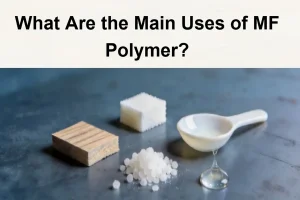
What Are the Main Uses of MF Polymer?
Tech Blog What Are the Main Uses of MF Polymer? If you work in wood‑based panel manufacturing, coatings formulation, plastic compounding or material procurement, you

Urea formaldehyde resin (UF resin) is the dominant adhesive for plywood, MDF, and particleboard, with annual global consumption exceeding 14.9 million tons. In daily manufacturing, large volumes of solid UF resin waste are inevitably generated due to improper operation, long-term storage sedimentation, incomplete curing, and batch production errors.
Cured solid UF waste is hard to biodegrade; direct landfill causes formaldehyde leaching and soil pollution, while incineration creates toxic exhaust and high disposal costs. Based on the reversible polycondensation reaction mechanism of UF resin, glyoxal-assisted thermal degradation is a low-cost, green recycling technology that breaks cured solid UF into low-molecular liquid resin precursors.
This article systematically analyzes the physical and molecular characteristics of glyoxal pyrolysis products, tests curing performance, and verifies plywood bonding performance with flour tackifier modification, providing a full industrial recycling workflow for wood adhesive manufacturers.
| Glyoxal:Solid UF Ratio | Solid Content | Viscosity (mPa·s) | pH | Visual State |
| 1:5 | 58% | 170.9 | 3 | Thick dark yellow paste |
| 1:7 | 55% | 81.6 | 3 | Moderate viscosity liquid |
| 1:9 | 54% | 71.95 | 3 | Thin watery solution |
1:5 Glyoxal Group (Highest Base Viscosity)
1:7 Glyoxal Group
1:9 Glyoxal Group
Q1 What solvent is best for thermal degradation of solid waste UF resin?
A: 40% aqueous glyoxal solution is the ideal choice. It hydrolyzes cured UF crosslinked networks under mild 85°C heating, generating low-molecular reusable oligomers without destroying core adhesive functional groups.
Q2 What flour addition ratio delivers the best plywood bonding strength?
A: 20% flour mass fraction relative to the degradation liquid is the optimal dosage for all glyoxal ratios, significantly boosting viscosity and forming crosslinked structures to enhance water resistance.
Q3 Does glyoxal recycled UF glue meet national plywood standards?
A: Yes. Under a 1:5 glyoxal ratio + 20% flour modification, plywood wet shear strength reaches 1.49 MPa, fully satisfying GB/T 9846 Class II plywood requirements.
Q4 Can wood panel factories adopt this waste UF recycling process on existing lines?
A: No equipment overhaul required. A degradation reactor can be added as an auxiliary unit, and hot-pressing parameters remain consistent with conventional UF production.
Q5 Why does unprocessed waste UF degradation liquid have poor water resistance?
A: Low viscosity leads to a loose cured polymer film with abundant hydrophilic gaps. Flour participates in co-condensation to build compact, hydrophobic crosslink networks, fundamentally solving hydrolysis defects.

Tech Blog What Are the Main Uses of MF Polymer? If you work in wood‑based panel manufacturing, coatings formulation, plastic compounding or material procurement, you
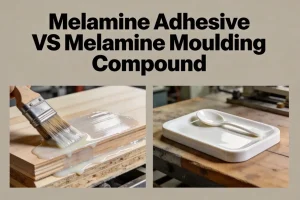
Tech Blog Melamine Adhesive VS Melamine Moulding Compound In the world of MF resins, there are two products that look similar but are fundamentally different:
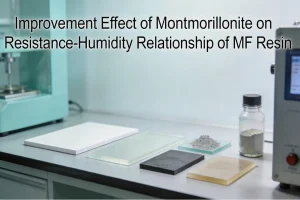
Tech Blog Improvement Effect of Montmorillonite on Resistance-Humidity Relationship of MF Resin Melamine formaldehyde resin (MF resin) is a well‑known thermosetting polymer used widely in

JINGJIANG MELAMINE POWDER
© JINJIANG MELAMINE