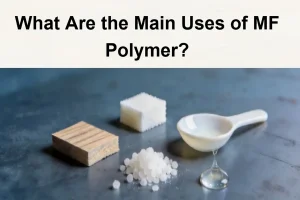

What Are the Main Uses of MF Polymer?
Tech Blog What Are the Main Uses of MF Polymer? If you work in wood‑based panel manufacturing, coatings formulation, plastic compounding or material procurement, you

Urea formaldehyde resin accounts for over 80% of global wood composite bonding materials and is widely used for plywood, particleboard, and medium-density fiberboard (MDF) due to its low cost, fast curing, high corrosion resistance, and fatigue tolerance.
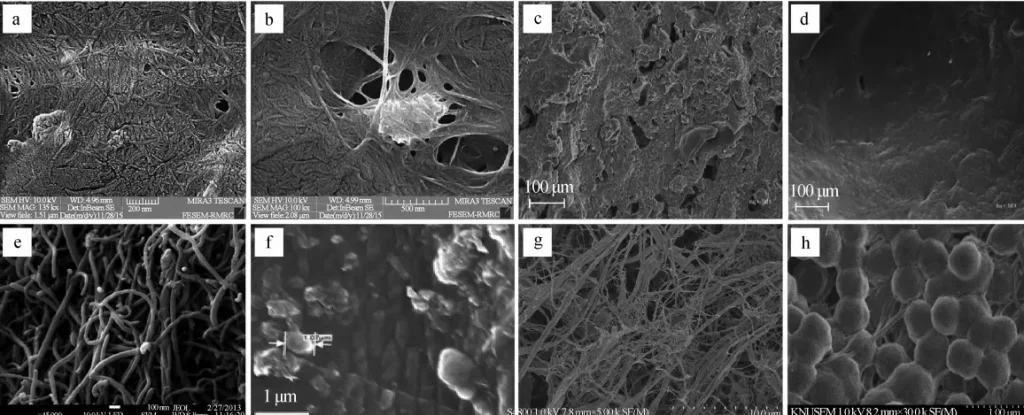
Traditional modification methods (melamine blending, formaldehyde/urea molar ratio adjustment) only deliver limited performance upgrades. Nanomaterials with ultra-large specific surface area, small-size effect, strong interface activity, and high reactivity have emerged as a breakthrough solution to simultaneously reduce formaldehyde emissions and upgrade the all-around mechanical, thermal, and antibacterial properties of UF adhesives.
This article breaks down three mainstream categories of nanomodifiers, their reaction mechanisms, and measurable performance improvements, supported by peer-reviewed laboratory data to assist the wood adhesive research and development team in nanomaterial modified urea formaldehyde resin adhesives research.
Viscosity & Solid Content
Nano fillers raise UF viscosity due to the surface small-size effect, yet excessive loading (>1.5% NCC, >5% nanoclay) triggers nanoparticle agglomeration and damages adhesive uniformity. Optimal dosage ranges from 1–3 wt% for most nano modifiers.
Water Resistance
Nanomodified UF forms a dense hydrophobic barrier layer after curing, cutting hydrophilic hydroxyl groups and slowing water infiltration:
Bonding Strength
Nanomaterial-Si-O or hydroxyl groups form dual chemical bonds with UF resin and wood fiber hydroxyl groups, eliminating weak interface layers. Nano MMT, NCC, and TiO₂ all produce plywood meeting the GB/T 9846-2015 standard (≥0.7 MPa bonding strength).
Elastic Modulus & Durability
After repeated hot-water aging cycles, OMMT-UF retains 63.6% higher elastic modulus than unmodified UF, demonstrating superior long-term structural stability for outdoor wood panels.
Tech Blog What Are the Main Uses of MF Polymer? If you work in wood‑based panel manufacturing, coatings formulation, plastic compounding or material procurement, you
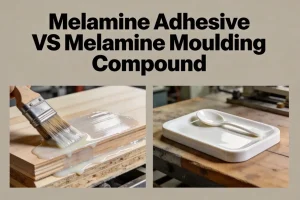
Tech Blog Melamine Adhesive VS Melamine Moulding Compound In the world of MF resins, there are two products that look similar but are fundamentally different:
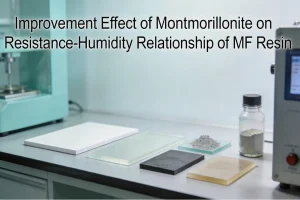
Tech Blog Improvement Effect of Montmorillonite on Resistance-Humidity Relationship of MF Resin Melamine formaldehyde resin (MF resin) is a well‑known thermosetting polymer used widely in

JINGJIANG MELAMINE POWDER
© JINJIANG MELAMINE