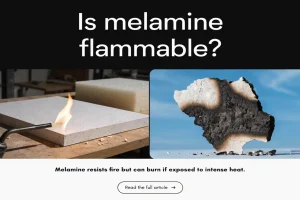

Is melamine flammable?
Tech Blog Is melamine flammable? “Is melamine flammable?” Many people mistakenly classify all plastic-like materials as flammable and worry about fire risks when using or

Q1: Can the method detect melamine in high-fat foods (e.g., cream, butter)?
A1: Yes. The sample pretreatment step (n-hexane extraction) effectively removes lipids. For high-fat samples, increase the number of n-hexane extractions to 3–4 times to eliminate interference.
Q2: How does the method compare to HPLC in terms of accuracy?
A2: For concentrations ≥1 mg/L, the spectrophotometric method’s accuracy is comparable to HPLC (RSD ≤2%). For ultra-trace detection (<0.89 mg/L), HPLC or GC-MS is recommended for confirmatory testing.
Q3: Is the method suitable for on-site testing?
A3: Yes. Portable UV-visible spectrophotometers (battery-powered) are available, and sample pretreatment can be simplified using disposable centrifuge tubes and field kits. It is ideal for on-site screening of dairy farms, food factories, and markets.
Q4: What is the shelf life of the standard reaction solution?
A4: The standard reaction solution is stable for 24 hours when stored at 4℃. For best results, prepare it fresh before each experiment.
The spectrophotometric method for melamine detection is a game-changing tool for food and feed safety. It combines cost-effectiveness, simplicity, and quantitative accuracy, making it accessible to basic laboratories and on-site inspectors. With a detection limit of 0.89 mg/L and a linear range of 1–100 mg/L, it meets the needs of routine screening and quantitative analysis for most food/feed matrices.
As food safety regulations tighten globally, this method provides an affordable alternative to expensive instrumental methods, enabling wider monitoring of melamine contamination. For quality control professionals, small manufacturers, and regulatory agencies, it is a practical, reliable solution to ensure product safety and compliance. With further optimization of reagents and equipment, the method’s detection limit can be reduced, expanding its application to ultra-trace melamine detection.
Tech Blog Is melamine flammable? “Is melamine flammable?” Many people mistakenly classify all plastic-like materials as flammable and worry about fire risks when using or

Tech Blog Why can’t melamine be microwaved? If you use melamine tableware for home dining, school cafeterias, or restaurant service, you have likely seen the

Tech Blog Is 100% Melamine Considered a Plastic? Shoppers, tableware buyers, and material engineers often ask a critical question: Is 100% melamine considered a plastic?

JINGJIANG MELAMINE POWDER
© JINJIANG MELAMINE