jinjiang melamine

Tech Blog

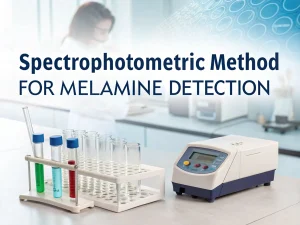
Spectrophotometric Method for Melamine Detection

The spectrophotometric method for melamine detection is based on the complexation reaction between melamine powder, formaldehyde, and carbonyl compounds and is suitable for detecting dairy products, candies, pet food, and feed. This article provides a detailed introduction to the principle, experimental procedures, performance indicators, and applications of spectrophotometry, providing practical guidance for quality control professionals, laboratory technicians, and food safety inspectors.

Why Spectrophotometric Detection for Melamine?

Traditional melamine detection methods have critical limitations for routine and on-site use:
  • High cost: HPLC/GC-MS equipment costs tens to hundreds of thousands of dollars and entails high maintenance and operational expenses.
  • Complexity: Sample pretreatment (e.g., derivatization for GC-MS) is time-consuming (1–3 hours) and requires specialized skills.
  • Low accessibility: Large, bulky instruments are not portable, making on-site testing impossible.
The spectrophotometric method addresses these gaps with key advantages:
  • Cost-effectiveness: Uses affordable UV-visible spectrophotometers (widely available in basic laboratories) and low-cost reagents (formaldehyde, α-naphthol, KOH).
  • Simplicity: Minimal sample pretreatment (protein precipitation, lipid removal) and straightforward operation (heating + spectrophotometric measurement).
  • Quantitative accuracy: Linear relationship between melamine concentration and absorbance (R² = 0.9969), enabling reliable quantitative analysis.
  • Versatility: Applicable to diverse matrices (milk, feed, candy, pet food) with minimal modifications to sample preparation.

Principles of the Spectrophotometric Method for Melamine Detection

The method relies on a specific complexation reaction and UV absorption characteristics:
  1. Reaction mechanism: Melamine powder(weakly alkaline, pH = 8) reacts with formaldehyde and α-naphthol (a carbonyl compound with active hydrogen) under heated conditions (80℃) to form a stable complex.
  2. UV absorption feature: The complex exhibits a unique maximum at 206 nm, while the individual reagents (melamine, formaldehyde, α-naphthol) show no significant absorption at this wavelength, ensuring high specificity.
  3. Quantitative basis: The absorbance at 206 nm is proportional to melamine concentration within a linear range of 1–100 mg/L. By measuring absorbance and referencing a calibration curve, melamine content can be accurately calculated.

Experimental Procedure: Step-by-Step Guide

1. Materials & Equipment

Reagents (All AR Grade)
  • Melamine standard (purity ≥99.0%)
  • Formaldehyde solution, α-naphthol, potassium hydroxide (KOH), hydrochloric acid (HCl), acetonitrile, n-hexane
  • Ultrapure water
  • Sample: Milk, feed, candy, or other suspected contaminated products (this study uses pure milk as a model)
Equipment
  • UV-visible spectrophotometer (e.g., Puxi General)
  • High-speed centrifuge (≥8000 r/min)
  • Digital constant-temperature water bath
  • Ultrasonic cleaner
  • Vortex mixer
  • Analytical balance (precision ≥0.1 mg)
  • Volumetric flasks (10 mL, 50 mL, 100 mL, 250 mL, 500 mL)
  • Pipettes (1 mL, 5 mL, 10 mL, 20 mL)
  • Microporous filter membranes (0.45 μm)

2. Solution Preparation

(1) Standard Melamine Solutions
  • Stock solution (5.0×10⁻³ mol/L): Weigh 0.3153 g of melamine into a 50 mL beaker, add water, stir, and transfer to a 500 mL volumetric flask. Rinse the beaker 2–3 times, add water to the mark, and heat in a 99.9℃ water bath to dissolve. Cool to room temperature.
  • Intermediate solution (5.0×10⁻⁵ mol/L): Pipette 2.5 mL of the stock solution into a 250 mL volumetric flask, add water to the mark, and shake well.
  • Working solution (1.0×10⁻⁵ mol/L): Pipette 20 mL of the intermediate solution into a 100 mL volumetric flask, add water to the mark, and shake well.
(2) Reagent Solutions
  • α-naphthol solution (1.0×10⁻⁴ mol/L): Weigh 0.0727 g of α-naphthol into a 50 mL beaker, dissolve in a small amount of ethanol, transfer to a 500 mL volumetric flask, rinse the beaker, add water to the mark, and shake well.
  • KOH solution (0.1 mol/L): Weigh 0.5607 g of KOH into a 50 mL beaker, dissolve in water, transfer to a 100 mL volumetric flask, rinse the beaker, add water to the mark, and shake well.
  • Standard reaction solution: Pipette 20 mL of α-naphthol solution, 5 mL of KOH solution, and 5 mL of formaldehyde solution into a 100 mL volumetric flask, add water to the mark, and heat in a water bath for 30 minutes to activate.

3. Sample Pretreatment

Follow GB/T 22388-2008 (National Standard for Melamine Detection in Milk and Dairy Products) for sample preparation:
  1. Protein precipitation: Pipette 1 mL of milk sample into a centrifuge tube, add 5 mL of acidified acetonitrile (pH = 2.0, adjusted with HCl), and sonicate for 10 minutes to precipitate proteins.
  2. Centrifugation: Centrifuge at 8000 r/min for 10 minutes, collect the supernatant.
  3. Lipid removal: Add 20 mL of n-hexane to the supernatant, vortex, and let stand. Discard the upper n-hexane layer (contains lipids). Repeat 2–3 times to fully remove lipids.
  4. Concentration & filtration: Evaporate the lower aqueous layer under reduced pressure to dryness, redissolve in ultrapure water, and filter through a 0.45 μm microporous membrane to obtain the sample solution for testing.

4. Detection & Analysis

  1. Reaction setup: Pipette 5 mL of the standard reaction solution into a 25 mL volumetric flask, add 2 mL of the sample solution (or standard working solution), add water to the mark, and shake well.
  2. Heating: Incubate the mixture in an 80℃ water bath for 30 minutes to promote complex formation.
  3. Absorbance measurement: Cool the mixture to room temperature, measure the absorbance at 206 nm using a UV-visible spectrophotometer (blank control: standard reaction solution without melamine).
  4. Quantification: Calculate melamine concentration using the calibration curve (y = 0.1689x + 0.1765, where y = absorbance, x = melamine volume/ concentration).

Performance Metrics & Validation

1. Key Performance Indicators

  • Linear range: 1–100 mg/L (R² = 0.9969), covering the critical concentration range for food/feed safety (most countries set limits ≤2.5 mg/L for food).
  • Detection limit: 0.89 mg/L (calculated as 3×standard deviation of blank solution / slope of calibration curve), meeting the requirements for screening and quantitative detection.
  • Precision: RSD = 1.6% for 5 parallel measurements of a 2 mg/L melamine standard solution, indicating high reproducibility.
  • Specificity: No interference from common food components (proteins, lipids, sugars) or other nitrogen-containing compounds—only the melamine-formaldehyde-α-naphthol complex absorbs at 206 nm.

2. Optimization of Reaction Conditions

  • α-naphthol concentration: 5 mL of 1.0×10⁻⁴ mol/L α-naphthol is optimal. Higher concentrations slightly increase absorbance but cause unnecessary reagent waste.
  • Reaction temperature: 80℃ ensures complete complex formation; lower temperatures result in incomplete reaction and lower absorbance.
  • Reaction time: 30 minutes is sufficient for maximum complex formation; longer times do not improve absorbance.

FAQ-Spectrophotometric Method for Melamine Detection

Q1: Can the method detect melamine in high-fat foods (e.g., cream, butter)?
A1: Yes. The sample pretreatment step (n-hexane extraction) effectively removes lipids. For high-fat samples, increase the number of n-hexane extractions to 3–4 times to eliminate interference.

Q2: How does the method compare to HPLC in terms of accuracy?
A2: For concentrations ≥1 mg/L, the spectrophotometric method’s accuracy is comparable to HPLC (RSD ≤2%). For ultra-trace detection (<0.89 mg/L), HPLC or GC-MS is recommended for confirmatory testing.

Q3: Is the method suitable for on-site testing?
A3: Yes. Portable UV-visible spectrophotometers (battery-powered) are available, and sample pretreatment can be simplified using disposable centrifuge tubes and field kits. It is ideal for on-site screening of dairy farms, food factories, and markets.

Q4: What is the shelf life of the standard reaction solution?
A4: The standard reaction solution is stable for 24 hours when stored at 4℃. For best results, prepare it fresh before each experiment.

conclusion

The spectrophotometric method for melamine detection is a game-changing tool for food and feed safety. It combines cost-effectiveness, simplicity, and quantitative accuracy, making it accessible to basic laboratories and on-site inspectors. With a detection limit of 0.89 mg/L and a linear range of 1–100 mg/L, it meets the needs of routine screening and quantitative analysis for most food/feed matrices.

As food safety regulations tighten globally, this method provides an affordable alternative to expensive instrumental methods, enabling wider monitoring of melamine contamination. For quality control professionals, small manufacturers, and regulatory agencies, it is a practical, reliable solution to ensure product safety and compliance. With further optimization of reagents and equipment, the method’s detection limit can be reduced, expanding its application to ultra-trace melamine detection.

Related Blogs

Melamine Modified Polyurethane
Jinjiang

Melamine Modified Polyurethane

Tech Blog Melamine Modified Polyurethane Polyurethane (PU) is a versatile polymer celebrated for its excellent wear resistance, oil resistance, chemical stability, and strong adhesion to
Read More »

Jinjiang chemical

Contact Us to Start Your Business