
jinjiang melamine

Tech Blog

Saturation Solubility Of Melamine Under Different Temperature And pH

Melamine is a widely used industrial chemical in resins, plastics, and coatings. In industrial production, waste recovery, and environmental treatment, melamine’s solubility in water is a critical parameter.

This article presents a comprehensive study of saturation solubility of melamine under different temperature and pH, including the fitted mathematical equation and its practical application.

Saturation Solubility Of Melamine Experimental Setup

Researchers tested melamine solubility under controlled conditions:
  • Solvent: deionized water adjusted to target pH with HCl/NH₃·H₂O
  • Temperature range: 294.15 K – 338.65 K (21 – 65°C)
  • pH range: acidic (pH < 7) and alkaline (pH > 7)
  • Method: excess melamine stirred to saturation; dried to measure dissolved mass
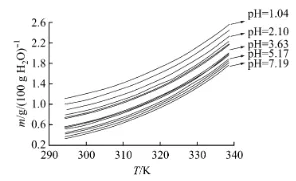
The solubility of melamine varies with temperature under different pH values (pH
The solubility of melamine varies with temperature under different pH values (pH<7)
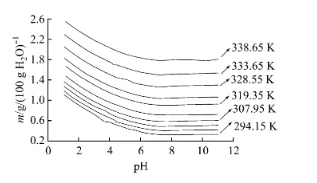
The solubility of melamine varies with pH at different temperatures

Key Findings: Temperature and pH Effects of Saturation Solubility Of Melamine

Solubility Increases With Temperature

At the same pH, melamine solubility increases continuously with increasing temperature. Higher temperature significantly improves dissolution.

Acidity and Alkalinity Both Boost Solubility

  • At the same temperature, solubility increases as the solution becomes more acidic or more alkaline.
  • The acid effect is much stronger: solubility increases much more in acidic conditions than in alkaline conditions.

Mechanism Behind the Change

Melamine reacts with acid/alkali and gradually hydrolyzes into:
  • Ammeline
  • Ammelide
  • Cyanuric acid
These products have much higher water solubility than melamine, especially under acidic conditions.

Practical Applications

Melamine is a high‑nitrogen organic compound with stable chemical properties, heat resistance, and good insulation performance. It is widely used in many industries:
  • Wood‑based panel industry: Melamine‑formaldehyde resin is used as an adhesive for plywood, particleboard, and flooring, providing strong bonding and water resistance.
  • Tableware & kitchenware: Melamine tableware (also called imitation porcelain) is lightweight, fall‑resistant, and durable, widely used in catering, schools, and fast‑food chains.
  • Coatings & paints: Improves hardness, adhesion, and weather resistance of coatings for metal, furniture, and construction surfaces.
  • Textile industry: Used as a finishing agent for fabrics to enhance wrinkle resistance, shrink resistance, and wash durability.
  • Paper industry: Improves water resistance, oil resistance, and the strength of paper and cardboard.
  • Leather processing: Used as a tanning agent to improve the softness and durability of leather.
  • Industrial materials: For manufacturing flame‑retardant materials, insulating parts, engineering plastics, and composite materials.
Given its widespread use, melamine waste and residues are common in industrial discharges. Understanding its solubility helps with recovery, treatment, and environmental protection.

conclusion

Saturation solubility of melamine under different temperature and pH:
  • Higher temperature → higher solubility
  • Stronger acid or alkali → higher solubility
  • Acidic conditions have a more significant effect.
  • The fitted equation accurately predicts solubility under pH < 7
These results provide reliable data and a mathematical model for melamine production, recycling, and environmental safety.

Related Blogs

Jinjiang chemical

Contact Us to Start Your Business