
jinjiang melamine

Tech Blog

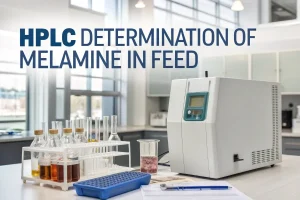
HPLC Determination of Melamine in Feed

Melamine contamination in feed and raw milk poses severe risks to animal health and food safety, as its high nitrogen content (66.7%) is illegally used to falsify crude protein levels. Traditional detection methods often involve toxic ion-pair reagents that damage chromatography columns and require frequent mobile phase changes. This study introduces a high-performance liquid chromatography (HPLC) method optimised from GB/T 22400-2008, enabling accurate melamine quantification in feed without column or mobile phase replacement. With a detection limit of 2.0 mg·kg⁻¹ and recoveries of 78.8–80.1%, this method is ideal for routine feed quality control, inspection laboratories, and feed manufacturers.

Why HPLC Is Ideal for Melamine Detection in Feed

Illegal melamine addition in feed artificially inflates protein readings, leading to kidney damage, reduced productivity, and even death in livestock and pets. Official methods like NY/T 1372-2007 use harmful ion-pair reagents that shorten column life and complicate operations.
The proposed HPLC method solves these problems:
  • No ion-pair reagents: Protects chromatography columns and reduces maintenance costs.
  • Stable mobile phase: pH 3.0 potassium dihydrogen phosphate buffer and acetonitrile, avoiding frequent solution changes.
  • Wide linear range: Covers 0.5–10.0 mg·L⁻¹, suitable for trace and semi-quantitative detection.
  • High precision: Relative standard deviation (RSD) < 8.10%, meeting national feed safety standards.

HPLC Determination of Melamine in Feed Experimental Setup

1. Instruments & Reagents

  • HPLC system: Agilent 1100 with DAD detector.
  • Chromatography column: SCX strong cation-exchange column (250 mm × 4.6 mm, 5 μm).
  • Standards: Melamine standard (purity ≥99%), methanol, acetonitrile (HPLC grade).
  • Extractants: Trichloroacetic acid (10 g·L⁻¹), lead acetate (22 g·L⁻¹).

2. Optimised HPLC Conditions

  • Mobile phase: pH 3.0 potassium dihydrogen phosphate buffer + acetonitrile (7:3, v/v).
  • Flow rate: 1.0 mL·min⁻¹.
  • Detection wavelength: 240 nm.
  • Column temperature: 30℃.
  • Injection volume: 20 μL.

3. Sample Pretreatment Steps

  1. Weigh 5.0 g crushed feed sample.
  2. Add trichloroacetic acid and lead acetate solutions, then ultrasonic extraction for 20 min.
  3. Centrifuge at 5000 r·min⁻¹ for 10 min, then collect the supernatant.
  4. Purify with an MCX solid-phase extraction (SPE) cartridge.
  5. Elute with ammonia–methanol (5:95), dry under nitrogen, redissolve, filter, and inject.

Advantages of HPLC Determination of Melamine in Feed

ItemProposed HPLC MethodNY/T 1372-2007 Standard
ReagentsNo ion-pair reagentsUses toxic ion-pair reagents
Column LifeLong (no corrosion)Short (easy damage)
Mobile PhaseStable, no frequent changesRequires frequent replacement
OperationSimple, fastComplex, time-consuming
Detection Limit2.0 mg·kg⁻¹Meets regulatory limits
Recovery78.8–80.1%Similar accuracy

Practical Applications & User Guide

This method is suitable for:
  • Feed mills and quality control labs.
  • Inspection and quarantine authorities.
  • Raw milk and feed ingredient testing.

Recommended Operating Tips

  1. Ensure complete ultrasonic extraction for 20 min to improve recovery.
  2. Use the SCX column for the best separation and peak shape.
  3. Maintain the mobile phase pH at 3.0 to ensure stable retention times.
  4. Filter all samples through a 0.45 μm membrane before injection.

conclusion

The HPLC method based on GB/T 22400-2008 provides a rapid, safe, and accurate method for determining melamine in feed. It eliminates harmful ion-pair reagents, extends column life, and delivers reliable results with high linearity, precision, and recovery. For laboratories and manufacturers monitoring feed safety, this optimised procedure is the ideal routine analytical tool to ensure compliance and protect animal and human health.

Related Blogs

Jinjiang chemical

Contact Us to Start Your Business