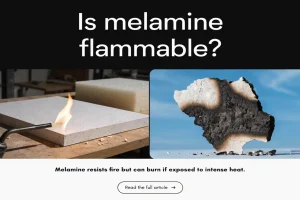

Is melamine flammable?
Tech Blog Is melamine flammable? “Is melamine flammable?” Many people mistakenly classify all plastic-like materials as flammable and worry about fire risks when using or

Melamine powder is a versatile industrial chemical widely used in high-end applications (e.g., bright powder, high-grade molding powder, decorative panels) and in mid- to low-end fields. However, traditional national quality standards for melamine (e.g., Grade A products) have overly broad key index ranges, failing to distinguish subtle quality differences. This leads to a “quality surplus” for mid- to low-end users and unmet requirements for high-end users (e.g., long dissolution time, poor solution transparency, surface bubbles in panels).
This article details the core drivers, grading standards, implementation measures, and practical effects of melamine powder quality grading management, providing actionable insights for melamine manufacturers, quality managers, and downstream users.
| Production Date | Load (%) | Particle Size Distribution (%) | |||
| <100 mesh | 100–120 mesh | 120–150 mesh | ≥150 mesh | ||
| 2010-02-03 | <50 | 11.5 | 71.1 | 5.2 | 12.2 |
| 2010-04-02 | 50–70 | 7.2 | 11.6 | 72.9 | 8.3 |
| 2010-04-25 | >70 | 3.4 | 7.6 | 10.6 | 78.7 |
| Product Batch | Original Turbidity | Retested Turbidity |
| 2010-02-12 | 3.39 | 19.8 |
| 2010-02-13 | 10.4 | 3.71 |
| 2010-02-23 | 1.37 | 20.9 |
| Indicator | National Standard (Grade A) | Refined Grade 1 (High-End Users) | Refined Grade 2 (Mid-End Users) | Refined Grade 3 (Low-End Users) |
| Appearance | White powder, no impurities | White powder, no impurities | White powder, no impurities | White powder, no impurities |
| Hazen Color Number | ≤20 | ≤5 | ≤10 | ≤20 |
| Kaolin Turbidity | ≤20 | ≤5 | ≤10 | ≤20 |
| Purity (%) | ≥99.8 | ≥99.8 | ≥99.8 | ≥99.8 |
| pH | 7.5–9.5 | 8.0–8.6 | >7.8 | 7.5–7.9 |
| Moisture (%) | ≤0.1 | ≤0.1 | ≤0.1 | ≤0.1 |
| Ash (%) | ≤0.03 | ≤0.03 | ≤0.03 | ≤0.03 |
Q1: Can small-to-medium melamine manufacturers implement this grading system?
A1: Yes. The core is not expensive equipment, but process standardization (e.g., load control, testing method refinement) and user segmentation. Small manufacturers can start with basic grading (high vs. mid-low end) and gradually refine indicators based on user feedback.
Q2: How to ensure consistent quality across batches for each grade?
A2: Key measures include: 1) Fixing production load ranges for each grade (e.g., >70% for Grade 1); 2) Standardizing testing methods (heating rate, sample size); 3) Conducting random online inspections during load adjustments; 4) Training operators to monitor pH and turbidity in real time.
Q3: Is there a risk of grade mislabeling during packaging?
A3: Mitigate risks with: 1) Color-coded packaging (e.g., white for Grade 1, blue for Grade 2); 2) Double-checks by quality inspectors before warehousing; 3) Traceability codes linking each batch to production load and test results.
Q4: How to handle users who require customized indicators (e.g., pH 7.6–7.8 for specific adhesives)?
A4: Expand the grading system to include “custom grades” by adjusting production load and process parameters. For example, produce a custom grade with pH 7.6–7.8 for adhesive manufacturers, and update user profiles to track customized requirements.
Tech Blog Is melamine flammable? “Is melamine flammable?” Many people mistakenly classify all plastic-like materials as flammable and worry about fire risks when using or
Tech Blog Why can’t melamine be microwaved? If you use melamine tableware for home dining, school cafeterias, or restaurant service, you have likely seen the
Tech Blog Is 100% Melamine Considered a Plastic? Shoppers, tableware buyers, and material engineers often ask a critical question: Is 100% melamine considered a plastic?

JINGJIANG MELAMINE POWDER
© JINJIANG MELAMINE