jinjiang melamine

Tech Blog

Are all atoms of melamine C₃H₆N₆ coplanar?

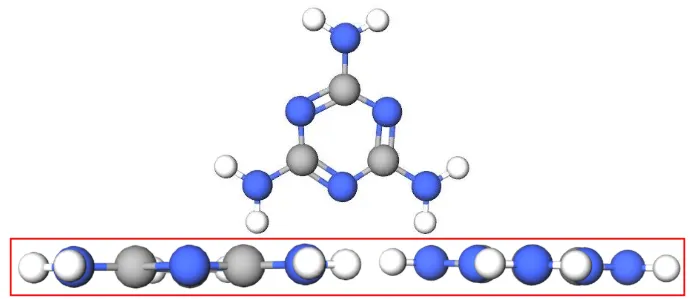
Melamine powder is a typical example of a planar p-π conjugated molecule, where all atoms are nearly coplanar, and all nitrogen atoms undergo sp² hybridization to maximize electron delocalization, reducing molecular energy and stabilizing the structure.

Cyanuric acid is a planar molecule that can form supramolecular compounds with melamine through hydrogen bonding, such as melamine cyanurate.

1

Why is the C₃H₆N₆ molecule a highly planar molecular structure?

Melamine molecular structure analysis: The core of melamine is a 1,3,5-triazine ring. This six-membered ring is similar to the benzene ring, possessing aromaticity and a π-conjugated system. To maximize this conjugation effect and minimize the molecular energy, all atoms on the ring (3 C and 3 N) must be in the same plane.

Analysis of N Connection on -NH₂: Three NH₂ are respectively connected to three Cs on the ring. Each amino N atom also adopts sp ² hybridization, and the lone pair electrons on it will conjugate with the large π bond system of the triazine ring, forming a larger delocalized system. This conjugation forces the nitrogen and hydrogen atoms of the amino group, as well as the carbon atoms connected to them, to be on this common plane.

Therefore, all 15 atoms (C₃H₆N₆) of the entire molecule (1 triazine ring+3 amino groups) are almost perfectly distributed on the same plane.

Why are all six nitrogen atoms in C₃H₆N₆ molecules sp² hybridized?

The first type of N: The hybridization mode of the three nitrogen atoms on the ring (triazine ring N) is sp² hybridization, with a bond angle close to 120°, perfectly forming a six-membered ring structure.

Each N atom in the ring forms two sigma bonds with the C atoms on both rings. There is also a pair of lone-pair electrons in N, occupying a sp² hybridized orbital, and one electron in the remaining p orbital that does not participate in hybridization. This electron participates in the formation of the aromatic π-conjugated system of the ring, similar to a benzene ring, but with a different distribution of electron clouds.

2

The hybridization mode of the second type N: the hybridization of the three nitrogen atoms (- NH₂) on the amino group is sp² hybridization, which is dominated by the “conjugation effect” rather than simply the number of bonds.

Each amino N atom forms 3σ bonds: 1 forms a C-N bond with the ring C atom, and 2 form N-H bonds with the H atoms. If based only on the number of bonding: 3σ bonds, it is easy to mistake it for sp³ hybridization. However, in reality, due to conjugation requirements, amino N adopts sp² hybridization, where 3 sp² hybridized orbitals form 3 σ bonds with bond angles of about 120° and a planar distribution. The unhybridized p orbitals accommodate 1 lone pair electron.

3

Analysis of p – π Conjugate Bonding: The lone pair electrons in the p orbital of amino N are not limited to the vicinity of the nitrogen atom, but will delocalize into the π – conjugated system of the entire triazine ring, overlapping with the conjugated π – system of the triazine ring, forming an extended conjugation of “ring amino”. Specifically, this lone pair occupies a p orbital parallel to the π-system of the triazine ring, and together form a large π bond. This significantly enhances molecular stability, the key driving force for sp² hybridization of amino N atoms. If the amino N is sp³ hybridized, lone pair electrons are in hybrid orbitals and cannot participate in conjugation, resulting in decreased molecular stability.

Due to the participation of lone pair electrons in conjugation, the amino group is no longer a standard “pyramid shaped” sp³ structure (such as methylamine). Still, it is “flattened”, making atoms such as N, H, C highly coplanar with the main ring.

Related Blogs

Jinjiang chemical

Contact Us to Start Your Business