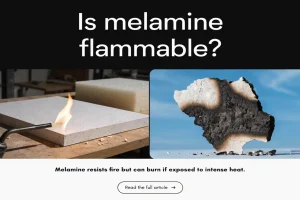

Is melamine flammable?
Tech Blog Is melamine flammable? “Is melamine flammable?” Many people mistakenly classify all plastic-like materials as flammable and worry about fire risks when using or

Melamine, a chemical substance that was once cast in a negative light in the public eye due to food safety incidents, is an indispensable core raw material in the field of materials science and the decorative industry. As a key component of the impregnated paper industry, melamine-formaldehyde resin endows wood-based panel decorative materials with excellent heat resistance, stain resistance, and surface hardness.
This article will delve into the technical principles, production processes, performance advantages, and the latest trends in functional innovation of melamine in the impregnated paper sector, providing professional insights for industry practitioners.
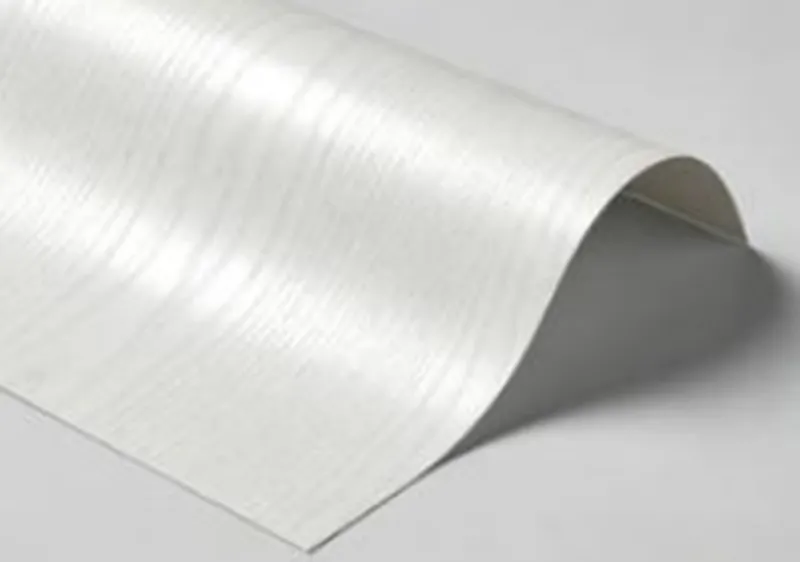
Melamine impregnated paper, technically known as melamine-impregnated film paper, is a type of adhesive paper produced by impregnating base paper (either solid color or printed decorative paper) with amino resins, primarily melamine-formaldehyde resin and urea-formaldehyde resin, and then drying it to a specific degree. This material is bonded to wood-based panel substrates (such as MDF, particleboard, and plywood) through a hot-pressing process, forming decorative panels widely used in cabinets, wardrobes, and laminate flooring.
From an industry chain perspective, the downstream application of melamine are diverse, with panels and impregnated paper being the largest application areas, together accounting for over 60% of the total. This data highlights the core position of the impregnated paper industry within the melamine sector. In recent years, although the melamine market has faced challenges of supply-demand imbalance due to adjustments in the real estate industry, the research and application of high-performance impregnated paper, driven by rising environmental standards and growing demand for functionalization, are emerging as new growth points for the industry.
Melamine impregnated paper production is a precise chemical and physical process procedure. A typical process flow includes: resin preparation → resin mixing (adding curing agents, release agents, penetrants, etc.) → first impregnation (with a mixture ofmelamine-formaldehyde resin and urea-formaldehyde resin) → first drying → second impregnation (with melamine-formaldehyde resin, forming the wear layer) → second drying → cooling and cutting.
The technical control during the impregnation stage is particularly critical. An innovative double impregnation process in the industry ensures full penetration of the resin into the paper base during the first impregnation, while the second impregnation focuses on forming the surface wear layer. This technique significantly enhances the surface properties and internal bonding strength of the final product.
Melamine-formaldehyde resin properties directly determine the final product quality.
Traditional impregnation resin systems suffer from issues such as brittleness, insufficient scratch resistance, and susceptibility to surface cracking. To overcome these technical bottlenecks, researchers have developed an “organic flexibility-inorganic reinforcement” ternary synergistic modification strategy. This involves compounding melamine-formaldehyde resin with waterborne hyperbranched polymers, flexible chain alcohol compounds, and inorganic nanoparticles. This technology utilizes mechanisms like chain segment embedding and network interpenetration to toughen the molecular structure of the impregnation resin and significantly enhance its surface scratch resistance.
Furthermore, the preparation of flexible melamine resin impregnation solutions is a key area of process innovation. By optimizing the synthesis process of urea-formaldehyde resin (using the alkali-acid-alkali three-stage method) and adding modifiers such as isocyanate, the flexibility and processing adaptability of the impregnated paper can be improved while maintaining the resin’s reactivity.
The quality of melamine-impregnated paper is primarily characterized by three key metrics: resin content (solid resin pick-up), volatile content, and pre-curing degree content (solid resin pick-up), volatile content, and pre-curing degree. The resin content determines the degree of filling of the paper base and the final surface performance. Volatile content affects storage stability and adaptability to hot-pressing. The pre-curing degree reflects the cross-linking state of the resin during the impregnation and drying stage, significantly influencing the curing speed and surface quality of the final product.
The prevalence of melamine impregnated paper decorative panels as the mainstream surface material for panel furniture and laminate flooring stems from their multiple performance benefits: wear resistance, diverse patterns, impact resistance, deformation resistance, stain resistance, flame retardancy, moisture resistance, environmental friendliness, and colorfastness. The three-dimensional network structure formed upon curing of the melamine resin endows the surface with excellent scratch resistance and chemical resistance. Simultaneously, a wide range of decorative effects, such as wood grains and stone patterns, can be achieved through printed decorative paper.
With increasing consumer focus on healthy living environments, antibacterial functionality has become a significant development direction for melamine-impregnated paper. Recent research indicates that decorative panels with efficient antibacterial properties can be prepared by modifying melamine-impregnated film paper with compounded nano-antibacterial agents (Ag/TiO2 and ZnO) .
Research data shows that with an addition ratio of 1% for the compounded nano-antibacterial agents, the antibacterial rates against Escherichia coli and Staphylococcus aureus reach 99.2% and 99.5%, respectively, demonstrating excellent antibacterial performance. The realization of this functionality relies on breakthroughs in surface modification technology for nano-antibacterial agents.
Researchers use silane coupling agents (KH560 and KH570) for surface organic modification. Without altering their chemical structure or crystal form, this method improves the surface tension of the nanoparticles through steric hindrance effects, effectively reducing particle agglomeration and enabling uniform dispersion within the melamine resin system. It is noteworthy that the physical and mechanical properties of melamine-faced panels incorporating these functional modifiers still meet the quality requirements of the national standard GB/T 15102-2017, “Surface decorated fiberboard and particleboard with paper impregnated thermosetting resins.” This provides a technical foundation for the industrial application of functionalized melamine-impregnated paper.
To meet the comprehensive performance requirements of impregnated paper in different application scenarios, product structure design innovation is gaining increasing attention. A representative innovative design features a multi-layer melamine-impregnated paper structure, typically comprising layers such as a wear-resistant layer, decorative layer, first moisture-proof layer, kraft paper layer, rubber layer, first adhesive layer, second moisture-proof layer, and second adhesive layer.
The advantage of this structural design lies in functional layering and synergistic enhancement: the surface wear-resistant layer guarantees scratch resistance; the intermediate moisture-proof layers effectively block moisture penetration while maintaining the flexibility of the kraft paper layer; the bottom rubber and adhesive layer design simplifies the on-site application process, allowing firm adhesion to the substrate without the need for additional glue.
This type offunctionally integrated product structure represents an evolutionary direction for impregnated paper, transitioning from a simple surfacing material to a multi-functional composite material.
Looking ahead, the melamine impregnated paper industry is expected to exhibit the following development trends:
The application of melamine in the field of impregnated paper represents a perfect synergy between chemically synthesized materials and the decorative industry. From basic surface protection to functional innovation, the technological evolution of melamine-impregnated paper continues unabated. Driven by the dual engines of environmental sustainability and functionalization, this traditional material is being revitalized, contributing to the creation of healthier and better living environments. Industry professionals should grasp these technological trends, increase investment in research and development, and propel the melamine impregnated paper industry towards sustained, high-quality, and high-value-added growth.
Tech Blog Is melamine flammable? “Is melamine flammable?” Many people mistakenly classify all plastic-like materials as flammable and worry about fire risks when using or

Tech Blog Why can’t melamine be microwaved? If you use melamine tableware for home dining, school cafeterias, or restaurant service, you have likely seen the
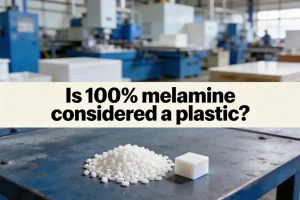
Tech Blog Is 100% Melamine Considered a Plastic? Shoppers, tableware buyers, and material engineers often ask a critical question: Is 100% melamine considered a plastic?

JINGJIANG MELAMINE POWDER
© JINJIANG MELAMINE