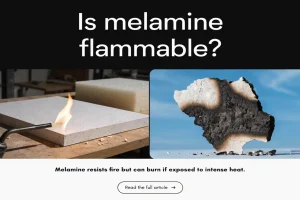

Is melamine flammable?
Tech Blog Is melamine flammable? “Is melamine flammable?” Many people mistakenly classify all plastic-like materials as flammable and worry about fire risks when using or

Turbidity and color are critical quality indicators for melamine powder—especially for export-oriented products—directly influencing product qualification and economic benefits. The formaldehyde method is widely used to measure these two indicators in industrial production, but its accuracy is affected by multiple factors.
The core conclusion: The accuracy of melamine turbidity and color measurement by the formaldehyde method depends on four key factors—heating temperature & time, chemical reagent quality (formaldehyde, NaOH), instrument performance, and operating procedures—with pH control of formaldehyde solution (8.3±0.2) and timely measurement after heating being the most critical.
This article analyzes each influencing factor, error mitigation strategies, and practical guidelines for chemical analysts, quality control personnel, and melamine manufacturers.
Turbidity: Reflects the content of insoluble impurities in melamine—measured by comparing the sample solution’s turbidity (kaolin units) with standard solutions using a turbidimeter (e.g., 2100N turbidimeter).
Color: Evaluates the degree of discoloration—determined by visual comparison with standard platinum-cobalt color standards (Hazen units) under a standard colorimetric row.
Melamine Turbidity (Kaolin Units) | ≤20 | ≤30 |
Melamine Color (Hazen Units) | ≤20 | ≤30 |
Purity (%) | ≥99.8 | ≥99.8 |
pH Value | 7.5–9.5 | 7.5–9.5 |
Temperature and heating duration directly impact sample dissolution and solution stability:
Too Short: Less than 10 minutes of constant heating at 80℃ results in incomplete sample dissolution and overestimation of turbidity.
Too Long: Exceeding 15 minutes of heating may induce premature resin formation, altering turbidity and color.
Formaldehyde and NaOH reagents are the most critical for measurement accuracy, with pH control being paramount:
Malfunctioning or uncalibrated instruments introduce systematic errors:
Formaldehyde Adjustment:
Reagent Selection:
Q1: Why does a temperature drop affect measurement results?
A1: Melamine powder reacts with formaldehyde at low temperatures to form insoluble melamine-formaldehyde resin, increasing turbidity and making color measurement impossible.
Q2: How to handle formaldehyde from different manufacturers?
A2: Adjust pH to 8.3±0.2 with 4% NaOH for each new batch and conduct control experiments with a trusted formaldehyde batch to confirm reliability.
Q3: Can turbidity meters replace visual colorimetry?
A3: No. Melamine Color is evaluated via platinum-cobalt standards, which require visual comparison. Turbidimeters only measure turbidity; use standardized colorimetric rows for color grading.
Q4: What if NaOH contains iron impurities?
A4: Filter the NaOH solution with a 0.45μm membrane to remove iron precipitates, or switch to high-purity NaOH with low iron content.
The formaldehyde method’s accuracy for melamine turbidity and color measurement relies on strict control of heating conditions, reagent quality, instrument performance, and operating procedures. The most critical steps are adjusting the formaldehyde pH to 8.3±0.2, maintaining a constant temperature of 80℃ for 10 minutes, and measuring immediately after heating.
By implementing the optimization strategies outlined—standardizing reagent preparation, regularly calibrating instruments, and training operators—manufacturers can eliminate errors, ensure consistent quality grading, and meet national and international standards. Accurate turbidity and color measurement are essential for maintaining product competitiveness, especially for export-oriented melamine products.
Tech Blog Is melamine flammable? “Is melamine flammable?” Many people mistakenly classify all plastic-like materials as flammable and worry about fire risks when using or

Tech Blog Why can’t melamine be microwaved? If you use melamine tableware for home dining, school cafeterias, or restaurant service, you have likely seen the
Tech Blog Is 100% Melamine Considered a Plastic? Shoppers, tableware buyers, and material engineers often ask a critical question: Is 100% melamine considered a plastic?

JINGJIANG MELAMINE POWDER
© JINJIANG MELAMINE